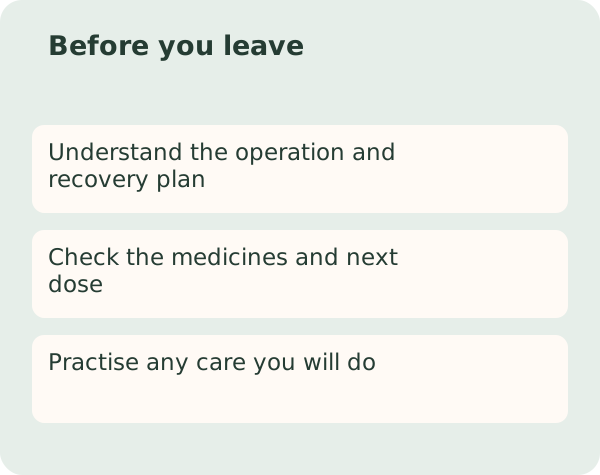
- Take an understandable operative summary.
- Resolve medication and care-task questions before leaving.
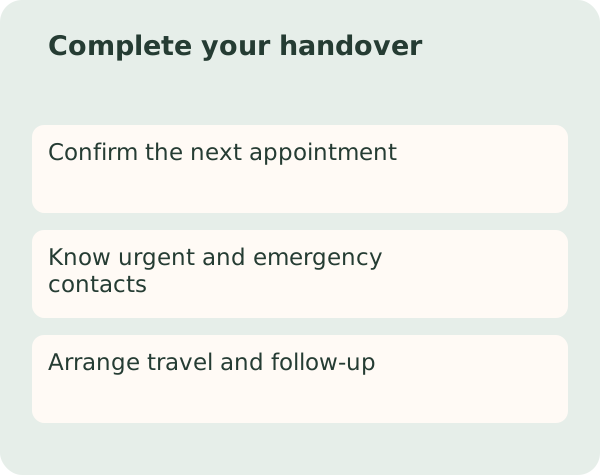
- Confirm the next clinical review and out-of-hours route.
Use the discharge conversation to resolve practical gaps
Discharge is a transition to the next setting of care. It does not mean that the wound has healed or that you can resume ordinary activities. NHS discharge guidance describes assessing what support a patient will need after leaving and involving the patient, with family or carers included when the patient agrees. Ask your own team who has assessed you and what arrangements they expect you to have. [1]
Bring up obstacles while staff can still help: you cannot read a medicine label, your companion is unavailable, the accommodation has difficult stairs, or a care task has not been demonstrated. Explain the actual problem rather than saying only that you are worried. Ask whether the plan needs to change, who will organise the change and what happens next. A transport booking or checkout time should not substitute for the clinical team's discharge decision.
Collect an accurate account of the operation
Request a discharge or operative summary that identifies you, the date, the surgeon, the facility and the procedures performed. Check your name and date of birth, particularly if documents use a different spelling or name order from your passport. Ask for the actual operation names rather than relying on a package description. If other procedures were performed, ask that they are recorded clearly.
The CDC's medical-tourism guidance supports obtaining medical records before returning home so subsequent clinicians can understand the care provided. For the immediate discharge, ask what information is available now and how you will receive anything still being prepared. Relevant details may include complications, important test results, allergies, devices remaining in place and the current care plan. [3]
Do not try to reconstruct missing clinical details yourself. If the summary differs from what you were told, ask the treating team to explain or correct it. Keep an accessible copy rather than packing every record away with your luggage.
Reconcile your regular medicines with the new prescriptions
Use one conversation with a clinician or pharmacist to establish which medicines you should take after discharge. Bring your preoperative medication list, including supplements and nonprescription products, and compare it with the new list. Ask which medicines are continuing unchanged, which are new, which have stopped and which are temporarily paused. For a paused medicine, ask who will decide when to restart it and how you will receive that instruction.
Swansea Bay University Health Board highlights the risks of outdated medication lists after discharge, including missed doses, continuing medicines that are no longer needed and duplicate supplies. This is particularly relevant when two clinicians or two countries are involved. A home clinician should not be assumed to have received or processed a foreign discharge letter. [4]
Resolve conflicting instructions with the clinical team before using the medicines. Do not choose between two different schedules based on convenience, and do not restart a previously paused medicine solely because you have left the hospital.
Check each label, the supply and the next dose
For every prescribed product, ask about its purpose, dose, timing, route, intended duration and any special instructions. Check that the label agrees with the written plan. Ask what has already been administered and when the next dose is due; this is especially useful if you feel tired or your companion is taking over practical help. Do not use this checklist to calculate an individual dosing schedule.
King's College Hospital advises reading medicine labels and leaflets, retaining original packaging, obtaining further supplies before running out and not sharing prescriptions. Ask your own team where you can obtain the medicines you need locally and whom to contact if a product is unavailable. Confirm storage requirements for each product rather than assuming all medicines can be kept in the same place. [5]
Ask what to do after a missed dose, vomiting or a suspected side effect. Check any proposed over-the-counter medicine with a clinician or pharmacist, including whether it repeats an ingredient already present in your prescription.
Practise the care tasks you will actually perform
A printed sheet is helpful, but being shown a task can reveal difficulties that a written instruction misses. ASPS identifies wound care, drains, medicines, warning signs and follow-up among the instructions patients should receive after abdominoplasty. Ask the team to demonstrate the tasks assigned to you or your companion, then explain or demonstrate them back while staff can correct misunderstandings. [2]
Distinguish tasks you can do from those that require a nurse or another professional. Ask who changes each dressing, how bathing affects it, what should remain untouched and when it will be reviewed. If you cannot comfortably see or reach the area, say so. If your companion will help, check that they are willing and able to do the task.
Identify the actual supplies, their quantities and how replacements are obtained. Do not substitute an unfamiliar dressing, cream or cleaning product because it looks similar. Ask for clarification when the product name on the instruction sheet differs from what you have been given.
Give any drain or device its own written plan
If you leave with a drain, record which device you have, where its instructions are and whom to contact about it. Ask what you must measure or record, how the device is secured and which changes require contact. Do not transfer another patient's drainage threshold or removal date to your situation. Different procedures and devices can require different care.
Memorial Sloan Kettering's Jackson-Pratt guidance describes supervised teaching before independent care and removal by a healthcare professional. This supports asking for a practical demonstration, but its device-specific instructions should not replace the plan for your own drain. [7]
Ask what to do if the tube is pulled, the collection system stops working, the drainage changes unexpectedly or you cannot carry out the care. Do not pull, reposition, remove or reinsert a drain yourself. A planned appointment for removal should remain a clinical decision, even if changing it affects your travel arrangements.
Turn activity restrictions into clear, usable instructions
Ask for advice about the activities you will actually need to do: getting into a vehicle, climbing steps, bathing, walking, lifting a child, using stairs at your accommodation and returning to work. Clarify which restrictions come from the anaesthetic, which come from the abdominal operation and whether any additional procedure changes them. A single statement such as take it easy can leave too much uncertain.
Chelsea and Westminster's abdominoplasty information describes early mobility alongside restrictions on heavy lifting. NHS general-anaesthetic guidance also warns that judgement and coordination may remain affected after waking. These principles do not establish your own walking schedule or a safe driving date. Ask the treating team to make those instructions specific. [8][10]
If you are given a compression garment, stockings or clot-prevention medicine, ask about each separately. Confirm how to use it, who can change the plan and which problems to report. Do not assume that wearing a garment replaces movement or a prescribed medicine.
Confirm the next appointment before you leave
Record the next review's date, local time, address and purpose. Ask whether it is with the surgeon, a nurse or another clinician and whether you need your companion or transport. Check whether a dressing, drain or medicine will be reviewed, and whether any photographs or records are requested beforehand. An intention to contact you later is different from a confirmed appointment.
UCLH's discharge checklist includes information about follow-up, an agreed care plan and contact numbers. Use those categories to check your own arrangements without assuming that a Korean clinic follows the same administrative system. [6]
If an appointment cannot yet be confirmed, ask who will arrange it, how you will hear and whom to contact if the message does not arrive. Save the instructions somewhere you can access without mobile data. Mention any difficulty attending before leaving so the team can consider an appropriate alternative rather than discovering the problem after a missed review.
Find out whether any results are still pending
Ask whether any test or report from your care is outstanding. Not everyone will have pending investigations, so this is a question rather than a reason to request unnecessary tests. If something is pending, note what it is, who will review it, how you will receive the result and what to do if you have not heard by the agreed time.
UCLH explains that different tests become available at different times and that some electronic results may be visible before a clinician has discussed them. Its advice is not to change treatment based on a result before speaking with the team. [9]
Ask whether the expected result could alter your medicines, follow-up or travel plan. A result appearing in an app does not necessarily mean someone has explained it, and a lack of a message should not be interpreted as reassurance. New symptoms still need assessment through the urgent-care plan while a result is pending.
Leave with a clinical contact route that works
Write down who handles routine questions, urgent concerns and emergencies. Include the operating facility's name, a clinical telephone number, after-hours arrangements and an alternative if the usual contact is unavailable. A coordinator may help with administration, but ask how you will reach a clinician who can decide whether examination is needed.
Use a concrete question before departure: if my wound becomes increasingly painful or starts leaking unexpected fluid this evening, whom should I call and where can I be seen? UCLH advises seeking medical advice immediately if a wound infection is suspected. A photo may help the team understand a change, but it should not become a reason to postpone a needed examination. [12]
Ask the team which symptoms require urgent contact in your particular case. If you cannot reach them promptly about an urgent concern, obtain local medical assessment rather than waiting for deterioration. Save the address of the recommended urgent-care facility as well as its name.
Keep emergency instructions separate from routine questions
Heavy or uncontrolled bleeding, loss of consciousness, sudden marked confusion or serious breathing difficulty needs emergency help. Sudden breathlessness or chest pain can also indicate a pulmonary embolism or another serious condition; do not drive yourself or wait for a clinic message. If someone is difficult to wake or has slow, shallow or irregular breathing, call emergency services immediately. Do not assume this is ordinary sleepiness after anaesthesia or pain medicine. If still in a facility, alert staff immediately. [13][14][20][21]
New pain or swelling in one leg needs urgent assessment, and associated breathlessness or chest pain calls for emergency help. If you suddenly cannot pass urine at all, seek emergency medical assessment immediately; do not wait for severe pain. These examples are not a complete list of complications or a way to diagnose yourself. [15][16]
In South Korea, call 119 for emergency medical help. Elsewhere, use the local emergency number. Confirm that your companion knows the accommodation address and can describe the recent surgery. Bring your medicine list and operation details if available, but never delay an emergency call to find paperwork, contact the surgeon or ask about payment. [17]
Check understanding and access, not just receipt of documents
Ask for the discharge explanation in a language you understand. If an interpreter is needed, arrange one for the clinical instructions rather than relying only on a booking conversation. Read back the key actions in your own words: what you will do, when you will do it and whom you will call if it is not possible. This is a practical way to expose uncertainty before you are on your own.
Check that electronic files open on your phone and that the text is readable. Keep an offline or paper backup of essential contacts and instructions. Ask who can provide a copy if the original is lost. Share relevant information with the person helping you through the agreed route, while keeping medical records away from public posts or unnecessary recipients.
Where two documents disagree, ask the issuing team which version is current. Date any revised instruction and keep the original context available for clinicians rather than silently combining old and new advice into your own plan.
Verify the handover to transport and your support person
Confirm who will collect you, where they should wait and how you will get from the vehicle into your accommodation. Tell staff if the actual arrangement differs from what was discussed before surgery. After general anaesthesia, Cambridge University Hospitals advises having a responsible adult continuously available for the first 24 hours. Your procedure may require assistance for longer. [11]
The practical question at discharge is whether the support is real and available, not just whether a name is written on a form. Check that your companion understands what help you need and has the same current instructions. Arrange other care for children or dependants rather than expecting to resume that role immediately.
If a care task or physical transfer is beyond your companion's ability, tell the team and ask what alternative support is appropriate. The first-night guide covers room setup and rest; this discharge check ensures that somebody can actually carry out the agreed handover.
Clarify travel documents, charges and unfinished administration
Before leaving, ask for any certificates, itemised documents or clinical summaries you will need for work, insurance or later medical care. Check names and dates. Keep financial receipts separate from the clinical account so that another doctor can find treatment information without sorting through a booking package.
Ask what follow-up is included, what an additional visit might involve and how extra care is arranged if the stay needs to be extended. NHS advice on cosmetic surgery abroad emphasises understanding aftercare, complications and possible additional costs before committing to treatment. Do not assume that a quoted package or travel policy covers every later problem. [18]
Being discharged to local accommodation does not establish fitness to fly. Ask who will assess travel readiness and what documentation an airline may request. If your condition changes, the travel plan may need to change too. Resolve administrative questions early where possible, but never postpone urgent assessment while responsibility for payment is being discussed.
A listed clinic to ask about its discharge process
VeryGood Plastic Surgery is listed in this atlas, and its official body-contouring page describes abdominoplasty. That makes it a relevant starting point for questions about a proposed tummy tuck, not proof that a particular discharge package or language service will be available to you. The public service description does not replace a written individual plan. [19]
Review the clinic profile and official service information, then ask who prepares the discharge summary, who checks medicines, who teaches drain care if required and how an unexpected concern is assessed after hours. Request confirmation of the actual treating surgeon and facility. Compare clear answers about responsibilities and access rather than promotional descriptions of recovery. You can ask another provider the same questions or postpone a decision if essential arrangements remain unclear.
Use a final check before the handover ends
Before leaving, ask yourself and your companion whether the important information is usable. Can you identify the current medicine plan and the next dose without guessing? Do you have the required supplies and know who performs each care task? Can you find the next appointment and the clinical contact route? Have you explained any obstacle to obtaining help or following the instructions?
Raise an unanswered question with the team rather than ticking a box merely because a form has been handed to you. Some records may follow later, but there should be an explicit arrangement for obtaining them. Do not mistake an administrative signature for understanding.
The purpose of this checklist is to make the agreed care possible after you leave. Your clinicians remain responsible for assessing discharge readiness, and your later reviews remain important. A clear handover gives you a practical next step for ordinary care and a route to help when something changes.
Explore the profiles mentioned in this guide
Use these source-linked profiles to prepare questions and confirm your individual plan directly.
Continue with the related guides
Arrange support and follow-up
Explore these related questions as you discuss your individual plan with your care team.
Put this information into your consultation
Use the consultation checklist and budget worksheet to record your questions. Explore tummy tuck clinics in South Korea and doctor profiles before asking a clinic about your individual plan.
Sources & further reading
Source links support the topic or the attributed provider details. Practical preparation prompts are editorial guidance. Checked 4 November 2026
- NHS: Being discharged from hospital ↗
- American Society of Plastic Surgeons: Tummy tuck recovery ↗
- CDC Yellow Book: Medical tourism ↗
- Swansea Bay University Health Board: Being prepared for going home after surgery or treatment ↗
- King's College Hospital: Managing your medicines after discharge ↗
- University College London Hospitals: Your leaving hospital checklist ↗
- Memorial Sloan Kettering: Caring for your Jackson-Pratt drain ↗
- Chelsea and Westminster Hospital: Abdominoplasty surgery ↗
- University College London Hospitals: Your test results ↗
- NHS: General anaesthetic ↗
- Cambridge University Hospitals: Information for adults who have had a general anaesthetic ↗
- University College London Hospitals: Preventing surgical wound infections ↗
- North West Ambulance Service: When to call 999 ↗
- NHS: Pulmonary embolism ↗
- NHS: Deep vein thrombosis ↗
- NIDDK: Definition and facts of urinary retention ↗
- Visit Seoul: Medical emergencies ↗
- NHS: Cosmetic surgery abroad ↗
- VeryGood Plastic Surgery: Official body-contouring service page ↗
- Dorset County Hospital: Opioids for acute pain relief ↗
- MedlinePlus: opioid breathing precautions ↗