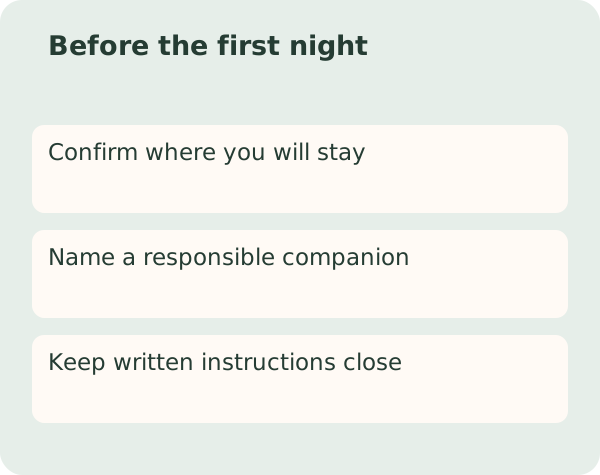
- Confirm the actual overnight arrangements.
- Have a written handover and an available companion.
- Know the clinical and emergency contact routes.
Where should you spend the first night?
There is no single overnight arrangement that suits every abdominoplasty. The NHS describes hospital stays after tummy tuck surgery, while the American Society of Plastic Surgeons also recognises outpatient surgery with an escort and overnight support. Neither description determines what is safe for you. Ask your surgeon what level of observation your health, operation and anaesthetic require, and what would change the plan on the day. [1][2]
A hospital bed, a clinic recovery room and a hotel room are different arrangements. If you are offered overnight accommodation, clarify who is physically present, whether they are clinical staff and how a problem would be assessed. A telephone coordinator is not the same as bedside nursing. If same-day discharge is proposed, explain honestly whether a suitable adult can remain with you. Do not conceal a gap in support because you have already paid for a room or arranged transport.
Understand what the anaesthetic can still affect
Waking up does not mean that your judgement and coordination have completely recovered. The NHS notes that the effects of general anaesthesia can last around 24 hours. Early drowsiness is expected, and staff can treat pain or nausea in recovery. At home, however, feeling unusually unwell should not simply be attributed to the anaesthetic without advice. [3]
Make the evening deliberately uncomplicated. Leave cooking, important decisions, work calls and caring for children to someone else. Avoid alcohol, driving and activities requiring steady coordination, and follow any longer restrictions your team gives you. Anaesthetic precautions are only part of recovery: permission to drive does not automatically return when the first 24 hours end, because abdominal discomfort, movement restrictions and medicines may still make it unsafe. If staff give you instructions while you feel hazy, ask your companion to listen and help you check the written version later.
Being difficult to wake or having slow, shallow or irregular breathing is not ordinary postoperative sleepiness. Call emergency services immediately. This is especially important when opioid pain medicines have been prescribed. [20]
Give your companion a realistic job
Arrange an adult who can stay with you, rather than someone who only drops you off or checks by phone. Cambridge University Hospitals advises constant responsible-adult support for the first 24 hours after a general anaesthetic. Your surgical team may recommend help for longer after a tummy tuck. The person should know what you can manage, how to contact clinical help and which tasks they have actually been taught. [4]
Before surgery, talk through likely interruptions: fetching a drink, helping you call for advice, accompanying you to the bathroom and keeping track of prescribed medicines. Consider whether the person can safely provide the physical assistance you may need. They should not attempt to lift you if they cannot do so safely. Arrange separate help for children, pets and other dependants so that you and your companion are not trying to cover two care roles at once. If support falls through, tell the clinical team before discharge.
Set up the room around the tasks you will need
A practical room matters more than a long shopping list. Put your phone, charger, prescribed medicines, drinking water when allowed and written instructions within comfortable reach. Keep a light available for bathroom visits and clear the route of luggage, loose objects and charging cables. Place everyday items at a height that avoids unnecessary bending or reaching. These are practical preparations, not substitutes for clinical supervision.
Think through access before the operation: Can you reach the bed without stairs? Is the bathroom nearby? Will the person supporting you be able to hear you? A very low sofa may be difficult to leave, while a very high bed may be difficult to enter. Ask the team whether your planned setup is suitable rather than assuming you need a specialist recliner. If equipment is advised, practise using it while well and ensure the companion understands it too. Avoid buying equipment on the promise that it will accelerate healing.
Find a supported resting position without forcing it
Your abdomen may feel tight, and lying fully straight can be uncomfortable soon after surgery. NHS tummy tuck advice includes keeping the knees bent in bed to reduce strain on stitches. An ASPS recovery article also describes resting at an angle early on. These are general descriptions, not instructions to choose a fixed angle or pile up a particular number of pillows. Ask the team to show you the position suitable for your operation. [1][5]
Discuss how to move into and out of that position before leaving supervised care. Tell staff if a suggested position causes pain, pressure or difficulty breathing. Do not force yourself flat to prove that recovery is going well, or stay in an uncomfortable position because someone online used it. Keep support stable and make sure it does not trap drain tubing. Rest may be interrupted by discomfort or care tasks; the first night's aim is a workable, safe arrangement rather than an uninterrupted sleep target.
Balance rest with the movement your team has prescribed
A tummy tuck is not a reason to remain completely still until morning. Chelsea and Westminster Hospital advises early short-distance walking after abdominoplasty, with the posture guided by the surgical team. NHS postoperative advice also explains that prolonged immobility contributes to blood-clot risk. The amount and timing of movement must account for your operation, dizziness, pain and any extra procedures. [6][7]
Ask when you should first get up, how much assistance you need and whether any overnight movement or exercises are specifically prescribed. Do not create a universal hourly walking schedule from an online guide. Have staff demonstrate safe transfers and let your companion observe when permitted. At home, ask for assistance before standing if you feel unsteady. Do not turn a short bathroom trip into an exercise session or carry luggage at the same time. Wear any prescribed stockings and use any prescribed clot-prevention medicine exactly as directed; walking does not replace them.
Make bathroom visits easier to manage
Bathroom planning is often more useful than another comfort product. Keep the route lit, leave room for your companion to assist and choose clothing you can manage without struggling around the dressing. Wirral University Teaching Hospital advises patients not to lock the bathroom door or make themselves inaccessible after a general anaesthetic. Agree on a way to call for help while preserving as much privacy as you want. [8]
Some patients have a urinary catheter after abdominoplasty; others do not. Chelsea and Westminster describes this as an individual part of postoperative care, so ask what applies to you. Do not adjust or remove a catheter yourself. [6]
If you suddenly cannot pass urine at all, seek emergency medical assessment immediately; do not wait for severe pain. [21] University Hospitals Sussex advises that this can require emergency-department assessment. Ask before leaving what to do if bladder discomfort develops, including where you should be seen overnight. [9]
Use the prescribed pain plan, not trial and error
Keep one clear record of medicines already given and any doses taken after leaving. This helps a tired patient and companion avoid confusion about whether a dose has been taken. Record what was actually taken, not just what was planned. Use the label and the clinician's instructions to determine timing; this article cannot provide a suitable dose or combination for your circumstances.
Ask which medicines are scheduled and which are only for particular symptoms. Check with a clinician or pharmacist before adding an over-the-counter product. Some combination pain medicines contain paracetamol (acetaminophen), so taking another product with the same ingredient can duplicate a dose. Ask a clinician or pharmacist to check each product. Gloucestershire Hospitals advises seeking help if substantial pain persists despite the recommended pain relief. Increasing the dose on your own is not the answer. [10][23]
Discuss sleeping medicines before surgery and do not add them to get through the night. NHS postoperative advice advises against sleeping tablets after anaesthesia. If you regularly take a sedating medicine, obtain an individual plan rather than abruptly changing it yourself. [9]
Keep food, drinks and nausea management straightforward
Ask staff when you may start drinking and eating, and follow any restrictions specific to your procedure or other conditions. NHS guidance says eating and drinking can usually resume when you feel ready, unless the hospital gives different advice. Some people have little appetite after anaesthesia. Have food available that is easy to manage rather than expecting to prepare a meal or go out that evening. [3][4]
If nausea occurs, use any prescribed treatment according to its instructions and tell the clinical team if it is not helping. Persistent vomiting, inability to keep fluids or necessary medicines down, or worsening abdominal symptoms deserve prompt advice. The Aesthetic Society advises contacting the surgeon for postoperative nausea or vomiting. [18] Do not automatically repeat a dose because you vomited after taking it; ask the prescriber or pharmacist what to do. Your companion can help describe when the vomiting occurred and which medicine was involved. There is no need to force a large meal, buy a recovery supplement or follow another patient's restrictive diet to make the night count as successful.
Leave dressings, drains and garments within the agreed plan
ASPS describes dressings, possible temporary drains and compression support as parts of tummy tuck recovery, with specific instructions for each patient's care. Before settling down, confirm whether anything needs to be checked overnight and who is expected to do it. A drain requires the instructions for that particular device, not a generic video or another clinic's removal schedule. [12]
Keep tubing secured in the way staff demonstrate and avoid placing it where it could be pulled when you change position. Do not remove a dressing for an unnecessary inspection, pull, reposition or remove a drain tube yourself, or tighten a garment because swelling worries you. Ask the clinical team about a dressing becoming soaked, a displaced tube or new pressure from the garment. UCLH advises avoiding touching wounds or dressings unless a professional has instructed you to do so, and cleaning hands first when care is necessary. Your companion should perform only care they have been taught and authorised to provide. [13][22]
Know which changes need help during the night
Ask for a short, personalised distinction between expected discomfort and a change that needs assessment. Pain and bruising can occur after abdominoplasty, but severe or rapidly worsening pain, increasing swelling or bleeding should not be dismissed as a normal part of the first night. A surgical team may need to examine you rather than advise by photograph alone. ASPS lists bleeding, fluid collections, infection and poor wound healing among possible complications; the appearance of one symptom cannot establish which problem is present. [1][14]
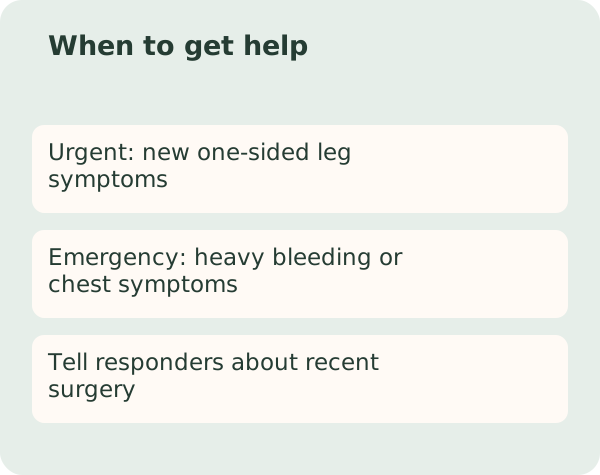
Use the agreed clinical contact route for concerns such as uncontrolled pain, persistent vomiting, difficulty passing urine or an unexpected wound or drain change. Say that you have just had an abdominoplasty and give the operation time, symptom and medicines taken. If you cannot reach the clinic promptly, seek urgent local assessment; do not wait for worsening. A promise to respond during office hours is not a reason to wait through deterioration.
Recognise when emergency care comes first
Heavy bleeding or bleeding that will not stop needs immediate emergency help. [25] Sudden breathing difficulty, chest or upper-back pain, a very fast heartbeat, loss of consciousness or collapse can signal a pulmonary embolism or another serious condition. Seek emergency help immediately rather than waiting for a coordinator's message. Severe illness with new confusion, very fast breathing or blue, pale or blotchy skin can also require emergency assessment, including for possible sepsis. Not every warning sign has to be present. New one-sided leg pain, swelling, warmth or discolouration also needs urgent in-person assessment because it can be a sign of deep vein thrombosis. [15][16][19]
In South Korea, call 119 for emergency medical help. Elsewhere use the local emergency number. Your companion should give the accommodation address, explain the recent operation and follow the emergency operator's instructions. Do not drive yourself, and do not delay while collecting photographs or contacting your insurer. Keep a medicine list and operation details accessible if they can be brought without delaying care. An emergency service, rather than a cosmetic-surgery booking team, should guide the immediate response to a potentially life-threatening problem. [15][17]
Plan the first morning without treating it as a deadline
Before going to sleep, know whether the following morning involves a clinic visit, a telephone call or continued inpatient observation. Confirm transport and assistance so that you are not arranging them while tired. If staff have requested a record of medicine use or drainage, keep it simple and accurate. Write down new questions as they occur rather than relying on memory after a disrupted night.
At review, describe what you could actually do: whether you could drink, take prescribed medicines, pass urine and move with the expected support. Mention problems even if they improved before the appointment. Ask what changes now, what remains restricted and whom to contact during the next night. A comfortable morning does not establish fitness for a flight, independent travel or a return to work. Recovery varies with the procedure and the person. If your team recommends more observation or assistance, rearranging plans is more useful than trying to meet a pre-booked timetable. [5]
Extra planning when the first night is in Korea
For an international patient, a familiar routine may be happening in an unfamiliar room and language. Save the accommodation address in Korean as well as the clinic address. Check that your companion can make local calls, knows the room number and can contact the front desk if access is needed. Keep essential instructions available offline so a lost signal does not remove your care plan.
Arrange interpretation for clinical concerns, not only for the initial consultation. Ask whether overnight advice reaches a clinician and how an in-person assessment would be organised. Confirm who can help if you need to remain longer than expected, without assuming that a hotel employee or driver provides nursing care. Your first night should be built around the actual operation and support you need. The most useful preparation is clear communication between you, your companion and the treating team, with enough flexibility to change plans when your condition requires it.
Discuss the first-night plan with a listed clinic
Verygood Plastic Surgery is listed in this atlas because its international body-contouring page describes abdominoplasty. This published service does not establish your suitability, a particular overnight arrangement, language support or independent clinical quality. Ask the named surgeon who will observe you, where you will sleep, what support a companion must provide, who answers after-hours concerns, and how urgent assessment is arranged. Confirm those details directly before booking. [24]
The clinic profile and international website below are starting points for questions, not a recommendation that this operation is right for you. Ask for a written plan in a language you understand, including the proposed anaesthetic, medications, discharge criteria, follow-up and any additional costs. You may seek another opinion or postpone your decision if the explanation or support arrangement remains unclear.
Explore the profiles mentioned in this guide
Use these source-linked profiles to prepare questions and confirm your individual plan directly.
Continue with the related guides
Prepare for discharge and support
Explore these related questions as you discuss your individual plan with your care team.
Put this information into your consultation
Use the consultation checklist and budget worksheet to record your questions. Explore tummy tuck clinics in South Korea and doctor profiles before asking a clinic about your individual plan.
Sources & further reading
Source links support the topic or the attributed provider details. Practical preparation prompts are editorial guidance. Checked 4 November 2026
- NHS: Tummy tuck (abdominoplasty) ↗
- American Society of Plastic Surgeons: Tummy tuck preparation ↗
- NHS: General anaesthetic ↗
- Cambridge University Hospitals: Information for adults who have had a general anaesthetic ↗
- American Society of Plastic Surgeons: What you need to know about your tummy tuck recovery ↗
- Chelsea and Westminster Hospital: Abdominoplasty surgery ↗
- NHS: Having an operation, after surgery ↗
- Wirral University Teaching Hospital: Advice following a general anaesthetic ↗
- University Hospitals Sussex: Adult day surgery discharge information ↗
- Gloucestershire Hospitals: Pain relief medication following day surgery ↗
- University Hospitals Dorset: Managing your pain after surgery ↗
- American Society of Plastic Surgeons: Tummy tuck recovery ↗
- University College London Hospitals: Preventing surgical wound infections ↗
- American Society of Plastic Surgeons: Tummy tuck risks and safety ↗
- NHS: Pulmonary embolism ↗
- NHS: Sepsis ↗
- Visit Seoul: Medical emergencies ↗
- The Aesthetic Society: Tummy tuck aftercare and recovery ↗
- NHS: Deep vein thrombosis ↗
- MedlinePlus: Morphine precautions ↗
- NIDDK: Urinary retention ↗
- MSK: Jackson-Pratt drain care ↗
- NHS: Paracetamol for adults ↗
- Verygood Plastic Surgery: body contouring ↗
- North West Ambulance Service: emergency symptoms ↗