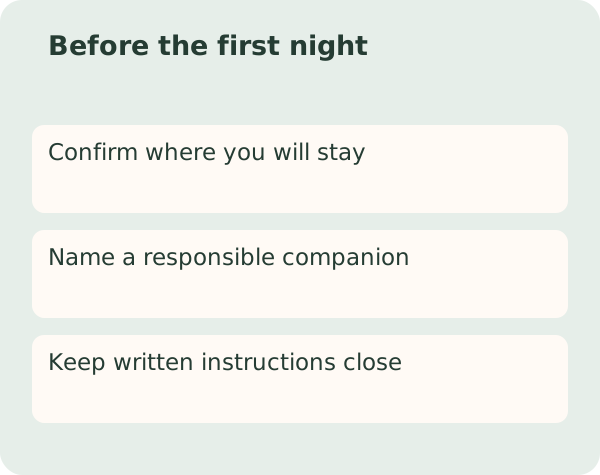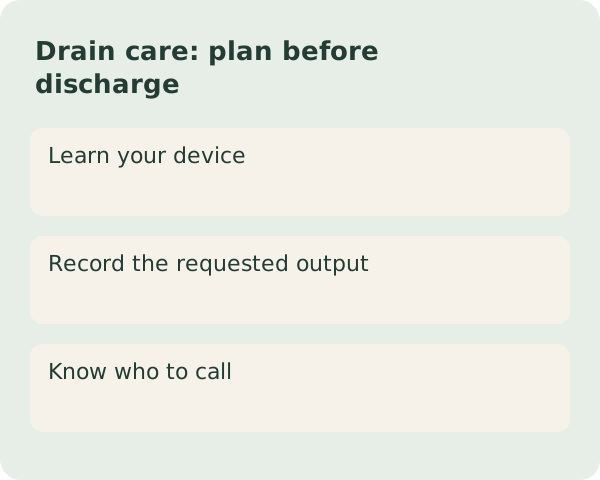
- Learn care using your actual drain.
- Keep the record your team requests.
- Never remove or reinsert a drain yourself.
What does your surgical drain do?
Drains differ, so ask the nurse to identify the device you have and explain its purpose. Cleveland Clinic describes several systems with different care requirements. A collecting bulb, a tube and the dressing around the entry site each have a role. Ask which parts you may handle and which should be left alone. Have the team demonstrate care using your actual equipment rather than a generic picture. If you cannot see or reach the area comfortably, explain this before discharge and ask whether your companion or a visiting nurse should help.
What drain output should you record?
Your team may ask you to record the amount and appearance of drainage. If there is more than one drain, ask how to label each one so records cannot be mixed. A simple note with the date, time and the observations requested by the nurse is preferable to a complicated spreadsheet. Confirm the units used and whether the clinic wants each emptying or a daily total. Do not interpret a number in isolation using another patient’s removal threshold. The clinician considers the operation, the pattern and your examination. Bring the record to every relevant visit.
How can you protect the tube during movement?
Ask staff how to secure the device while getting dressed, using the bathroom and moving around. Arrange clothing and bags so they do not unexpectedly pull the tube. Discuss showering explicitly: permission depends on your dressings and the surgical plan. If you use a support garment, ask how the tubing should pass through or around it. Do not cut or alter the device to make it fit. Before travelling between accommodation and clinic, plan where the collecting container will sit and ask your companion to carry luggage so your attention can remain on moving safely.
When should you call about a drain?
A tube that falls out, a drain that unexpectedly stops working, a marked change in fluid or increasing wound symptoms should be discussed with the clinical team promptly. Follow the instructions provided for your device. Do not reinsert a displaced tube, remove a stitch or attempt to correct a problem with household equipment. When you call, describe the event, the time it occurred and any other symptoms. A photograph may assist communication if the team requests one, but it should not delay assessment when you feel unwell. Ask what to do while travelling to be seen.
When and where will drains be removed?
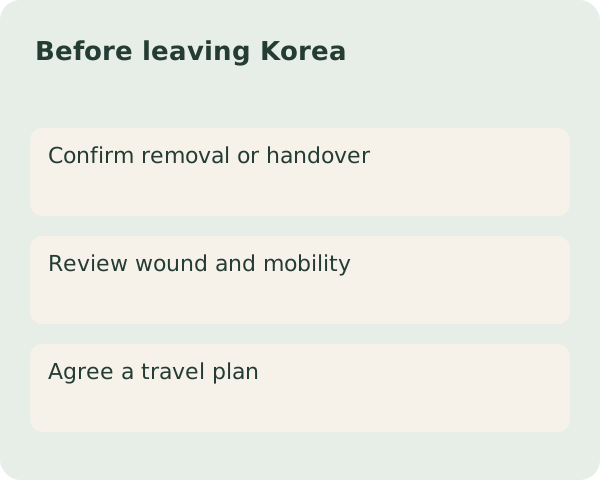
Removal is a clinical procedure. Ask who will perform it, where and what follow-up is needed afterwards. If output or your examination means removal is delayed, ask whether your accommodation or onward travel needs to change. Clarify how to care for the small drain opening once the device is removed. Keep contact details available because removal does not end the possibility of a fluid-related concern. Before leaving Korea, confirm whether any remaining device requires a specifically arranged clinician at home. Do not assume any local clinic will accept responsibility without prior agreement.
Before surgery: ask which fluid-management plan is proposed
A drain is a temporary route for fluid to leave a space created during surgery. Your surgeon may use a closed collection system, or may recommend a different approach. Ask what is planned for the exact procedure, including any liposuction or abdominal-wall repair, and whether the plan could change during the operation. A “drainless” description does not mean fluid problems are impossible, nor does the presence of a drain establish that something went wrong. Ask how fluid collections will be assessed under either plan. [2][3]
A useful written plan names the person who will teach you, the device expected, the first review date and the contact route outside office hours. Ask whether the clinic normally discharges people with a drain and what accommodation and transport arrangements would be appropriate. If your stay has a fixed checkout date, ask what happens if the drain is needed longer. The answer should be practical rather than a promise that removal will happen by a particular day.
Understanding the collection system without improvising
The tube, collection container and dressing are connected parts of a clinical device. Some systems use gentle suction, but not every drain is managed in the same way. Ask the nurse to show you how yours works, including what it looks like when correctly secured and what to do if the container changes shape or the connection becomes loose. Repeat the demonstration back while someone watches. Your companion should learn too if they will help. [2][4]
Clean hands and the instructions supplied by the treating team matter. Ask which supplies to take, how to store them, how to dispose of used materials, and whether a replacement dressing should ever be applied outside the clinic. Never pull, cut, flush, strip or reconnect a drain merely because a video describes it. Those actions may not be appropriate for your device; contact the clinical team for instructions. If the tube falls out, do not push it back in. Cover or protect the area only as directed and arrange assessment.
Recording fluid: useful context for the clinician
If asked to measure output, agree a simple method before leaving. Record the date and time, amount in the unit your team specifies, which drain produced it and the appearance in ordinary words. If there are two drains, keep their records separate. Ask whether the team wants each measurement or a total over a specified interval, and whom to contact if the amount changes unexpectedly. A nurse can check that your measuring cup and written record are practical. [4]
The quantity alone is not a self-removal instruction. Teams may use different thresholds and also consider the trend, time since surgery and examination. For example, an NHS leaflet describes one local threshold, but that is not a rule for every surgical team. A sudden stop can mean several things and should not be interpreted as proof that the space is healed. Do not wait for a planned appointment if the device is displaced, no longer appears to function or fluid changes markedly. [2]
Making daily activities manageable
Before discharge, practice moving from the bed to a chair, walking a short distance and using the bathroom with the drain secured as instructed. Ask how to position the container when sleeping and how to prevent accidental pulling when dressing. Choose loose clothing that does not snag, but do not create an opening in a prescribed garment unless the team approves. Ask who will carry luggage, collect meals and accompany you to early appointments. Your ability to reach the equipment safely is more important than whether another person online managed independently.
Clarify bathing and showering separately. Instructions may depend on your dressing, incision and device; do not assume that a water-resistant dressing permits a bath, pool or shower. Ask which products are permitted near the opening and when a nurse should change the dressing. If you are staying in a hotel, arrange a clean, well-lit place to follow the plan and a direct transport route back to the clinic.
Troubleshooting and when to seek help
Ask for two routes before leaving: an urgent clinical contact for drain or wound concerns, and the local emergency service for emergency symptoms. Report a drain that comes out, suddenly stops as compared with the expected pattern, or develops a marked change in fluid; also report increasing redness, fever, worsening swelling, spreading pain or new leakage as instructed. The team may ask about the time, amount, colour and associated symptoms. A requested photograph can help communication, but it is not a substitute for an examination. [2][4]
Sudden or severe breathlessness, chest pain, collapse or major uncontrolled bleeding requires emergency assessment rather than a message to an aesthetic clinic. A painful swollen leg also requires urgent medical assessment. Tell clinicians about the recent operation and drain. Do not delay getting help to gather records; if available, bring the discharge summary and medication list.
Removal, travel and handover
Removal is decided and performed by the treating clinician or another clinician who has explicitly accepted responsibility. Ask how the site will be dressed, whether another visit is needed and what changes should prompt review. Fluid may still collect after removal, so ask what a new or enlarging swelling should trigger. Do not remove a device yourself to meet an airline departure or hotel booking. Confirm your surgeon’s separate assessment of wound healing, mobility and clot risk before travel. [2][3]
If a drain might remain when you leave Korea, arrange a named receiving clinician in advance rather than assuming a home clinic can accept the work. Ask for an English discharge summary with the operation, device, output record, medications and the next agreed action. Confirm how a delay affects your accommodation and costs. The right departure date is an individual clinical decision, not the date another patient posted online.
A Korea consultation option and questions
VeryGood Plastic Surgery is listed in this atlas because its international body-contouring page describes abdominoplasty. Its published service is a starting point for a consultation, not evidence of a particular drain technique, a guarantee or an independent quality ranking. Ask the named operating surgeon whether a drain is planned for your operation, who teaches care, how follow-up is arranged, and what happens if removal or travel is delayed. Review the clinic profile and international website below, then confirm current services and surgeon assignment directly. [5]
Bring your itinerary, accommodation address, companion’s availability and contact details of any clinician at home. Request an answer in a language you understand and ask for it in writing. Compare written plans on after-hours access and handling complications, not just whether drains are advertised. It is reasonable to seek another opinion or postpone booking if you cannot establish who will manage an unexpected change.
Explore the profiles mentioned in this guide
Use these source-linked profiles to prepare questions and confirm your individual plan directly.
Continue with the related guides
Put this information into your consultation
Use the consultation checklist and budget worksheet to record your questions. Explore tummy tuck clinics in South Korea and doctor profiles before asking a clinic about your individual plan.
Sources & further reading
Source links support the topic or the attributed provider details. Practical preparation prompts are editorial guidance. Checked 3 November 2026