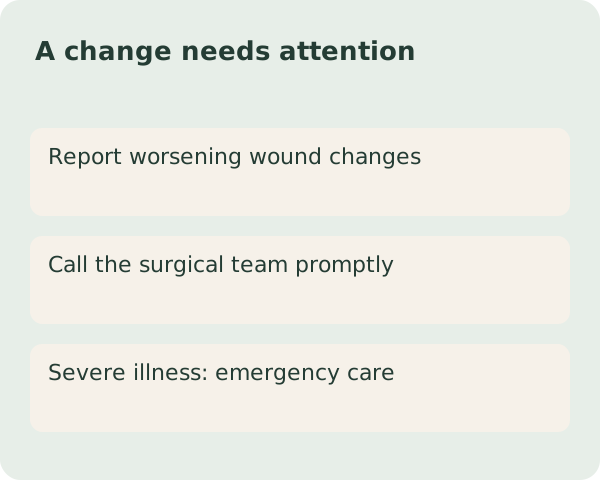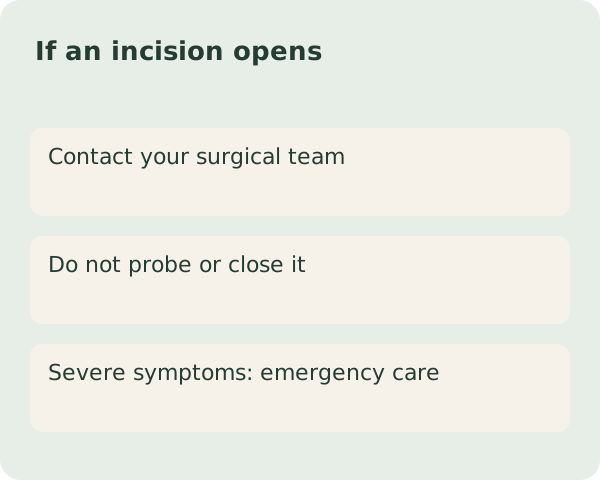
- Contact your surgical team promptly about any incision opening.
- Seek emergency help for protruding tissue, major bleeding or severe illness.
- Do not close, probe or pack the wound yourself.
What does an opening in the incision mean?
An incision that has begun to pull apart after being closed is sometimes called wound dehiscence. The visible gap may involve a small area of skin or extend deeper. You cannot judge the depth or the right treatment reliably from a photograph, an online comparison, or the size of the visible surface alone. Contact the operating team promptly if any part of the incision opens, even if the area is small or not very painful. Tell them if it is enlarging, draining, bleeding, or accompanied by a change in how you feel. They can decide whether you need an urgent examination. [1][2]
After a tummy tuck, the incision commonly runs low across the abdomen; some people also have an incision around the navel. Your exact closure, dressing and other procedures may differ. A surgeon may use layers of sutures beneath the skin as well as closure on the surface. A visible opening does not tell you which layers are affected. An individual assessment can also distinguish separation from a dressing edge lifting, a superficial raw area or another change. Do not assume an online example identifies your own wound.
Which symptoms require emergency help?
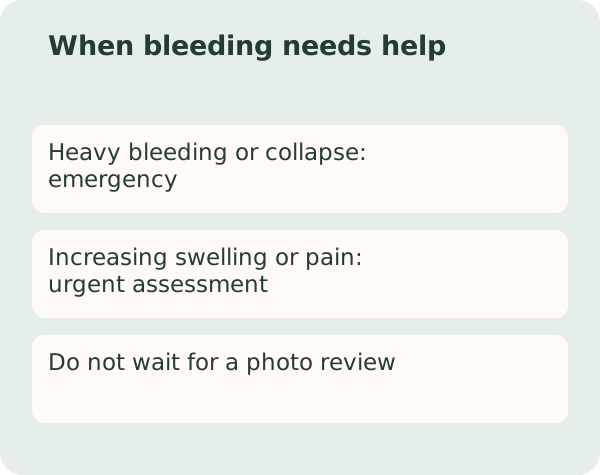
If tissue or an organ is protruding through an abdominal wound, or if you have heavy bleeding, collapse, sudden or severe breathing difficulty, chest pain, or rapidly worsening severe illness, seek emergency medical care immediately. Do not push protruding tissue back or try to close the opening yourself. If possible, tell emergency staff that you recently had abdominal surgery, but do not delay care while looking for records. Cleveland Clinic describes protrusion of internal tissue through an open wound as a medical emergency. [1]
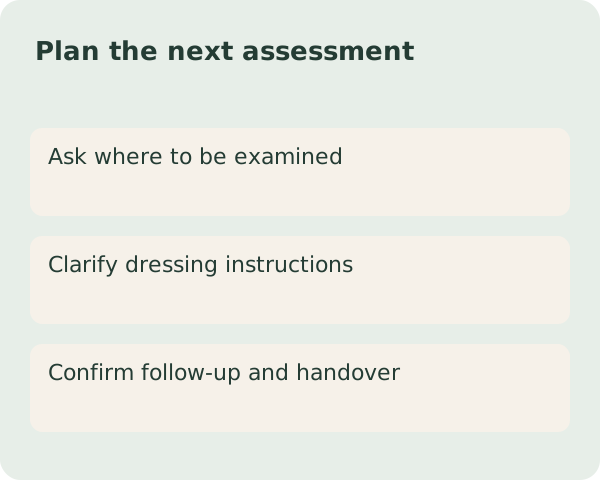
For a new opening without these emergency features, contact your surgical team promptly and follow its direction about where to be examined. Increasing pain, spreading redness or warmth, a marked change in drainage, fever, or feeling increasingly unwell can also require prompt medical review. These signs can overlap with infection, but their absence does not prove that a gap is harmless. If you cannot reach the surgical team and the condition is worsening, seek assessment through an appropriate local urgent-care or emergency service rather than waiting for a message reply. [2][3]
What should you do while arranging assessment?
Follow the discharge instructions you were given and ask the treating team for specific interim advice. Avoid attempting to tape the edges together, remove stitches, probe the opening, pack it, or apply creams, powders, antiseptics or other products unless a clinician who knows the wound directs you to do so. Keep hands clean before any contact with a dressing. If the dressing becomes wet, loose or soiled, ask the team what to do with the supplies you were given rather than guessing which products are suitable. [1][2]
Do not test whether the wound can tolerate exercise or stretching. Ask which movements and positions are safe for your situation, and arrange for a companion to help with bags or transport. At the same time, do not make a prolonged bed-rest plan on your own: safe mobility and clot prevention need individual direction. If you are dizzy, unwell, or unable to travel safely, explain that when you call and use emergency services when appropriate. A requested image can help staff triage an issue, but a photograph does not replace an examination and must not delay urgent help.
What information helps the surgical team?
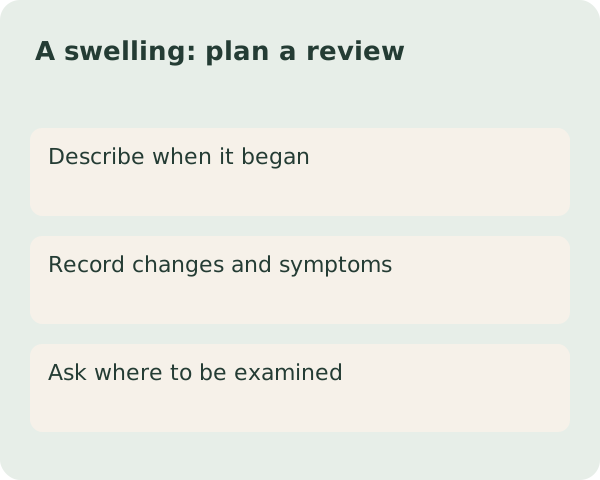
Before leaving hospital or clinic, ask for an English-language discharge summary that names the operation, date, operating surgeon, closure and dressing plan, current medicines, any drains, and a reachable contact for the next assessment. If you notice a gap, describe when you first saw it, whether it has changed, where it lies along the incision, and whether there is bleeding or drainage. Tell staff about fever, worsening pain, new swelling, and how you feel overall. If the team asks for a photo, ask how to send it securely and what response time to expect. [2]
Mention any condition or treatment that may affect healing, such as diabetes, smoking, medicines that suppress immunity, or a recent infection. Do not stop prescribed medicines without discussing them with the prescribing clinician. Ask what should trigger another call if you are waiting for a review, who covers the service overnight, and whether an interpreter can be arranged. If your current location is not close to the operating clinic, provide your address and ask whether you should attend the clinic, a local hospital, or an emergency service.
How might the wound be assessed?
A clinician will ask about your symptoms and examine the wound, including the area around it and, when appropriate, the depth and extent of the separation. They may assess circulation, fluid, signs of infection, pain and other health factors. The team can decide whether the opening needs a dressing plan, tests, closer observation, a procedure, or hospital assessment. Not every opening is managed in the same way, and an image in a forum cannot tell you which approach is appropriate. [1][3]
A culture, antibiotic or procedure is not automatically needed for every open area; the clinician decides after assessment. Conversely, a small-looking opening can still need attention. Ask the clinician to explain the working diagnosis, the immediate aim of care, the signs that mean the plan must change, and when the wound will next be reviewed. If additional treatment is proposed, ask about its benefits, risks, alternatives, costs and who will perform it. Avoid promising yourself that a particular dressing, device or operation will be necessary or successful.
Will the wound be closed again?
Some wounds are managed with dressings and monitored as they heal; others need a different procedure or more urgent intervention. The choice depends on depth, tissue condition, infection and your overall health. A provider may explain why closing a wound immediately is or is not appropriate, what care is needed between visits, and what the expected uncertainty is. Do not compare the number of appointments with another patient’s experience as if the wound type were identical. [1]
Ask who changes dressings, what is included in the written quote, and whether a companion can be taught any task that is genuinely safe to do outside a clinic. If the team recommends a product, check how it is used, how to replace it, and what to do if you cannot obtain the same item after travel. Keep instructions in a language you understand, and ask for clarification when a translated instruction is unclear. If you are given medication, confirm its purpose, schedule, important warnings and who to contact about side effects.
Why might healing take longer for some people?
Healing is influenced by the operation, tissue tension, blood supply, health conditions, smoking and other individual factors. These are topics for a consultation, not reasons to blame yourself or predict the outcome from one factor. Tell the surgeon about diabetes control, nicotine use including vaping, nutrition, allergies, prior wound problems, and all medicines or supplements. Ask which changes are advisable before and after surgery and who will help you make them safely. [1][2]
If a complication is present, your surgical team may alter activity, dressings or follow-up. Ask whether walking and prescribed prevention measures remain appropriate and how to recognize a separate problem. New chest pain or sudden or severe breathing difficulty is not a routine wound question and needs emergency assessment. A painful swollen leg requires urgent clinical advice. A well-organized recovery plan makes these escalation routes explicit rather than expecting you to distinguish every complication on your own.
Planning a safe stay in Korea
Before booking, ask the clinic to put follow-up visits, after-hours contacts and a complication plan in writing. A fixed hotel checkout or return flight should not determine whether an opening is healed. If recovery changes, your surgeon may advise another review or an adjustment to your travel plan. Ask who can assess you on weekends, whether the clinic can assist with language interpretation, and where emergency care is available. Arrange flexible accommodation and transport if possible.
If an opening develops near departure, do not assume that a remote photo alone clears you to fly. Ask for a specific decision about your wound, mobility, clot risk, dressings and access to care in transit. Confirm whether there is an extra charge for unplanned follow-up and how complications are handled. Travel and medical insurance terms vary, so check directly what is covered; this is not a promise that a particular policy will pay. If an insurer requests records, ask the surgical team how to obtain them securely.
Handover to a clinician at home
Before leaving, ask for a concise record of the operation, what happened to the wound, its current assessment and the treatment plan. Include medicines, allergies, dressing products, last and next review dates, laboratory or imaging results if available, and the clinic’s contact details. Ask the receiving clinician whether they can accept the handover and provide the necessary follow-up; do not assume that an appointment, supplies or specialist service will be available immediately. Ask the surgeon how the two teams can communicate.
A planned handover does not replace an urgent assessment for a worsening wound. If symptoms worsen during the journey, obtain local care rather than waiting to reach home. Record the treatment dates and materials used, and tell the treating clinician about the recent surgery. Once home, ask the receiving clinician what healing changes to expect, how frequently they will examine the area and how to contact them between visits. A second opinion can be useful if the diagnosis or next steps are unclear.
Questions for a tummy-tuck consultation
VeryGood Plastic Surgery is listed in this patient atlas because its international body-contouring service describes abdominoplasty. That listing supports discussing the operation there; it does not verify who would treat a complication, guarantee a particular wound outcome, or establish an independent quality ranking. Review its international service and the atlas profile, then confirm the named surgeon, current arrangements, and suitability directly. [4]
Ask: Who examines an opening after office hours? Where will I be seen if I am ill? What follow-up is included, and what may cost extra? What records and instructions will be supplied in English? If I have to delay travel, who coordinates the next visit? What will happen if I return home before care is complete? Compare the clarity of these answers as well as the procedure description. You may seek a second opinion or defer a booking if you do not understand the proposed aftercare.
Frequently asked questions
Can a tiny gap wait until my scheduled review? Contact the team promptly for individualized advice. The surface size alone does not establish the depth or tell you whether infection or another issue is present. Describe the gap and associated symptoms, then follow the direction you receive. [1][2]
Should I use an adhesive strip to close it? Do not try to close the wound yourself. A clinician who has examined it may provide a specific dressing or closure plan. A strip or product that was suitable for a different wound may be inappropriate for yours.
Can I bathe or swim? Ask the treating team. Water exposure depends on the wound, dressing, stage of healing and current plan. Do not assume a waterproof dressing makes a bath, pool or sea safe.
Does an opening mean the entire result is lost? Not necessarily, but no one can predict the outcome from a description alone. The immediate priority is a safe assessment and a wound plan; discuss scar appearance and later options when the clinician says the wound is ready for that discussion.
Can I travel home if the wound is still open? Ask your treating clinician, or another qualified clinician who examines you and has the relevant records, to assess readiness. Confirm the dressing plan, access to supplies, a receiving clinician and what to do if the wound changes during travel. Ask for a written handover and ensure you can contact care at your destination.
Explore the profiles mentioned in this guide
Use these source-linked profiles to prepare questions and confirm your individual plan directly.
Continue with the related guides
Put this information into your consultation
Use the consultation checklist and budget worksheet to record your questions. Explore tummy tuck clinics in South Korea and doctor profiles before asking a clinic about your individual plan.
Sources & further reading
Source links support the topic or the attributed provider details. Practical preparation prompts are editorial guidance. Checked 3 November 2026