
- A published waiting period is not individual fit-to-fly clearance.
- Ask the surgical team to assess the complete journey and provide a specific travel plan.
- Seek urgent or emergency care for warning symptoms rather than trying to preserve a flight booking.
How long should you wait before flying?
The CDC Yellow Book advises avoiding air travel for 10 days after chest or abdominal surgery. NHS advice for cosmetic surgery abroad describes a seven-to-ten-day period without flying after a tummy tuck. These are general recommendations with different scopes, not proof that departure on day seven or ten is appropriate for you. [1][2]
Ask your surgeon for a provisional stay before booking and a reassessment after the operation. Explain whether you expect a short regional flight or a long journey with connections. If a clinic’s standard package is shorter than the stay recommended for your case, ask how it will accommodate that difference. Do not choose between published numbers simply by taking the earliest. The useful question is: what needs to be assessed before this particular journey can go ahead? Keep the answer separate from the date your hotel booking ends.
Why recent surgery changes the travel discussion
A deep vein thrombosis, or DVT, is a clot in a deep vein, often in a leg. A pulmonary embolism occurs when a clot travels to the lungs. Prolonged sitting and recent surgery are relevant risk factors, so the return journey deserves more attention than ordinary holiday travel. [3][4]
Tell your clinician about previous clots, family history, a known clotting disorder, estrogen-containing medicines, recent pregnancy, and other health conditions. Do not stop prescribed medicines yourself; ask the prescribing and surgical teams to coordinate. [4]
Make a short travel-history note before the consultation. Include the outward journey, the proposed return route, and any long car or train transfer. That gives the team something specific to assess. A healthy travelling companion’s experience, or another patient’s uncomplicated flight, does not establish your own risk. Avoid using a general travel-risk percentage as a personalized forecast after an operation.
What should the pre-departure review resolve?
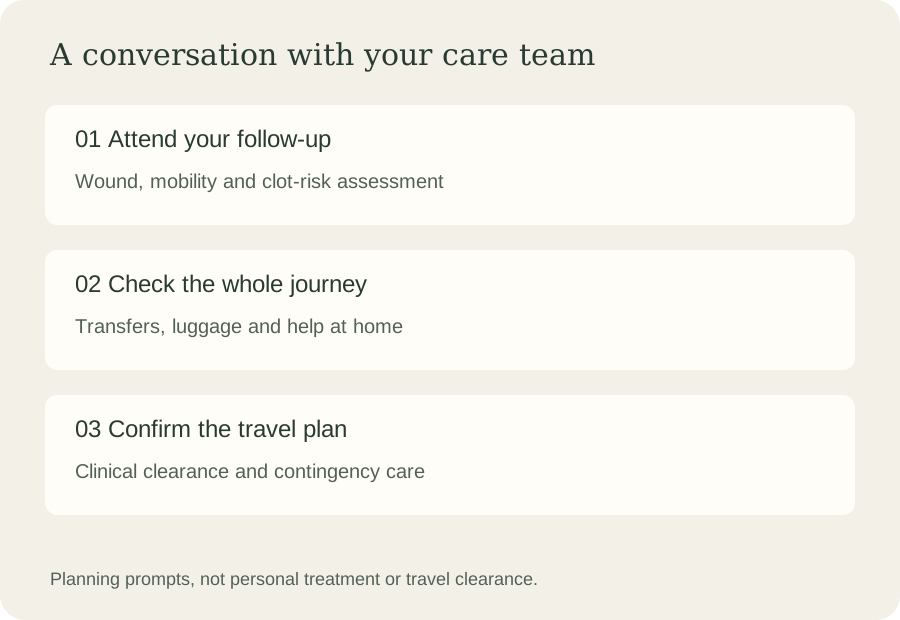
Bring three questions to the review: does my recovery still fit the proposed departure date, what care is needed before I leave, and what would make you change your advice? Ask the team to discuss your wound, mobility, pain-management plan, drains if present, and scheduled follow-up in the context of travel. These are discussion prompts, not a self-clearance score.
Show the actual itinerary. Say who will accompany you and whether you must manage stairs, luggage, transfers, or a long wait alone. Ask for any travel instructions in writing and clarify when another assessment would be needed if the flight is delayed. Keep the date and the clinician’s name with the advice. A letter records an assessment made at a particular time; it does not mean you should ignore a new concern on the morning of departure.
When should you seek care instead of boarding?
New pain and swelling in one leg can be signs of DVT and need urgent medical assessment. Do not wait until you reach home to have a suspected clot checked. [5]
Sudden difficulty breathing, chest or upper-back pain, a very fast heartbeat, or collapse can indicate pulmonary embolism or another serious condition and require emergency help. [6] In Korea, call 119 for a medical emergency. [7] At the airport or on board, alert staff immediately so they can obtain help.
For other postoperative changes, use the warning-sign instructions your team supplied rather than assuming all discomfort belongs to normal recovery. If you are awaiting assessment of a new concern, tell the clinician that a flight is imminent. The threshold here is obtaining appropriate care before continuing travel, not proving a diagnosis yourself. A ticket, insurer authorization, or unanswered coordinator message should not delay necessary medical attention.
Discuss clot prevention without self-prescribing
Ask which movement and leg exercises are suitable during your journey and how they fit your postoperative restrictions. CDC travel guidance supports walking and calf movement during prolonged travel, while prevention choices for people at higher risk require individual assessment. [3][4]
Do not start aspirin, injections, or another blood thinner to make an early flight seem acceptable. Ask your clinician whether stockings or medication are appropriate and obtain exact instructions if prescribed. Medicines used to prevent clots can also cause bleeding, so someone must assess the balance for you. Drinking water is reasonable but has not been established as a stand-alone way to prevent travel-related clots. [3]
Write down who will answer medication questions during the trip. If two clinicians give instructions that seem inconsistent, ask them to clarify before departure. Keep your plan simple enough that you and your companion can explain it accurately; do not add products suggested by a forum or package seller.
Plan the whole journey, not only the time in the air
Create a door-to-door schedule from accommodation checkout to arrival at home. Mark transfers, queues, connections, baggage collection, and periods when help will be unavailable. A shorter flight with several transfers may be harder to organize than its headline duration suggests; a direct flight may still involve a long period seated.
Ask the airline what assistance is available, how to request it, and whether it includes help through connections. Confirm who handles your luggage rather than relying on a stranger at an overhead locker. Ask about any medical form or supporting documentation the airline requires for your circumstances; requirements can differ, so check with the carrier actually operating each flight.
For seating, discuss practical access to the aisle and toilet with the team and airline. Extra space may improve comfort, but paying for a premium cabin does not replace clinical assessment or the agreed prevention plan. Leave room in the schedule to move at your own pace rather than planning a tight connection.
What if you still have a drain or need another review?
Do not treat drain removal, a photograph that looks reassuring, or an improvement in comfort as an automatic travel permit. Ask whether the remaining care can be completed before departure and who would manage it afterwards. The travel decision should account for your actual needs, not just a single milestone.
If an additional review is requested, ask when it will occur and what it is intended to resolve. Tell the clinic immediately if that conflicts with checkout or the flight. Avoid arranging unplanned drain removal or transferring care informally just to preserve the booking. Request a clear clinical handover if another professional will take over.
For example, a patient whose final review is booked after hotel checkout has a practical conflict even before any medical finding changes. Move the administrative deadline so the assessment can influence the next step. This is a planning example, not a prediction about how long drains should remain in place.
Make a postponement plan you can actually use
Before paying for travel, identify the change conditions for your flight, companion’s flight, and accommodation. Record the contact details, any known fees, and who can make changes if you are occupied with care. Ask whether the current room can be extended and keep a second option if it cannot.
Separate three possible expenses: additional routine follow-up, an extended stay, and treatment for a complication. Ask the clinic which services are included and ask the insurer about your actual planned surgery rather than an ordinary holiday. NHS guidance cautions that standard travel insurance does not normally cover problems arising from surgery abroad. [2]
Do not assume a surgeon’s letter guarantees reimbursement. Keep receipts and the relevant policy wording, but make the clinical decision first. If your budget cannot accommodate any change, raise that constraint before booking the operation. Waiting until support and finances are workable remains an option.
Carry the information the next clinician will need
Request the operative summary, discharge instructions, medication list, and follow-up plan before leaving Korea. CDC advises medical tourists to obtain records for subsequent clinicians and disclose treatment received abroad. [1]
Keep a practical copy in hand luggage and an offline digital version. Add the clinic’s clinical contact, your accommodation details until departure, and the person meeting you at home. Ask the team to explain any unclear translation rather than attempting to reconstruct technical details during a later appointment.
Arrange the first home follow-up through the agreed route. A remote photo check may be part of care, but ask what happens if an examination is needed. Tell a clinician about new symptoms after the journey, including when surgery and travel occurred. Reaching home does not turn the original recovery instructions into optional advice or make an unresolved concern something to manage through social media.
A listed clinic and doctor to consider for a recovery-planning consultation
SoonPlus Plastic Surgery and Dr. Jong Min Lim are relevant starting points for a consultation about abdominal surgery and the recovery arrangements a return journey may require. SoonPlus’s international site advertises mini and full tummy tucks. Its doctor biography identifies Dr. Lim as a director and plastic surgeon, while the team page describes a body-contouring focus. [8][9][11]
The clinic also publishes an abdominoplasty recovery guide that names him as its reviewer and describes remote photo follow-up for international patients. Those are clinic-published statements, not an independent audit of credentials or outcomes. [10] They support asking focused questions; they do not establish specialist aviation expertise or promise that a particular departure date is safe.
Review the SoonPlus and Dr. Lim profiles, then use the official international website to ask who would operate, which reviews must happen before departure, and how care is handled if travel is postponed. Confirm availability and the written terms directly. This selection is based on published abdominal services and relevant follow-up information, not a ranking or guarantee.
Frequently asked questions about the return flight
Can I book a flight for the earliest published waiting period? Treat that period as a point to discuss, not a personal clearance. Ask for a provisional schedule, a review before departure, and a workable alternative if the advice changes. [1][2]
Does a shorter flight remove the concern? No. Recent surgery and your individual circumstances still need assessment; include ground transfers and connections when describing the trip. Long-distance travel by car or train can also involve prolonged limited movement. [3]
Should I take aspirin just for the flight? Do not start it yourself. CDC’s public travel advice does not recommend aspirin for preventing travel-related clots; if you already take it for another reason, ask your clinician how to manage it. [4]
Can airport assistance replace a companion? Ask exactly what assistance covers. Terminal transport is a different service from personal support with medicines, communication, meals, and the onward journey.
What if I feel better than expected? Tell the surgeon, but keep the review. Feeling more comfortable is useful information, not a substitute for assessing the operation, recovery needs, and travel plan.
Explore the profiles mentioned in this guide
Use these source-linked profiles to prepare questions and confirm your individual plan directly.
Continue with the related guides
Put this information into your consultation
Use the consultation checklist and budget worksheet to record your questions. Explore tummy tuck clinics in South Korea and doctor profiles before asking a clinic about your individual plan.
Sources & further reading
Source links support the topic or the attributed provider details. Practical preparation prompts are editorial guidance. Checked 25 October 2026
- CDC Yellow Book — Medical tourism ↗
- NHS — Cosmetic surgery abroad ↗
- CDC Yellow Book — Deep vein thrombosis and pulmonary embolism ↗
- CDC Travelers’ Health — Blood clots during travel ↗
- NHS — Deep vein thrombosis ↗
- NHS — Pulmonary embolism ↗
- Korea Tourism Organization — Emergency situations ↗
- SoonPlus — Published mini and full tummy-tuck services ↗
- SoonPlus — Dr. Jong Min Lim biography ↗
- SoonPlus — Abdominoplasty recovery and international follow-up ↗
- SoonPlus — Team and body-contouring focus ↗