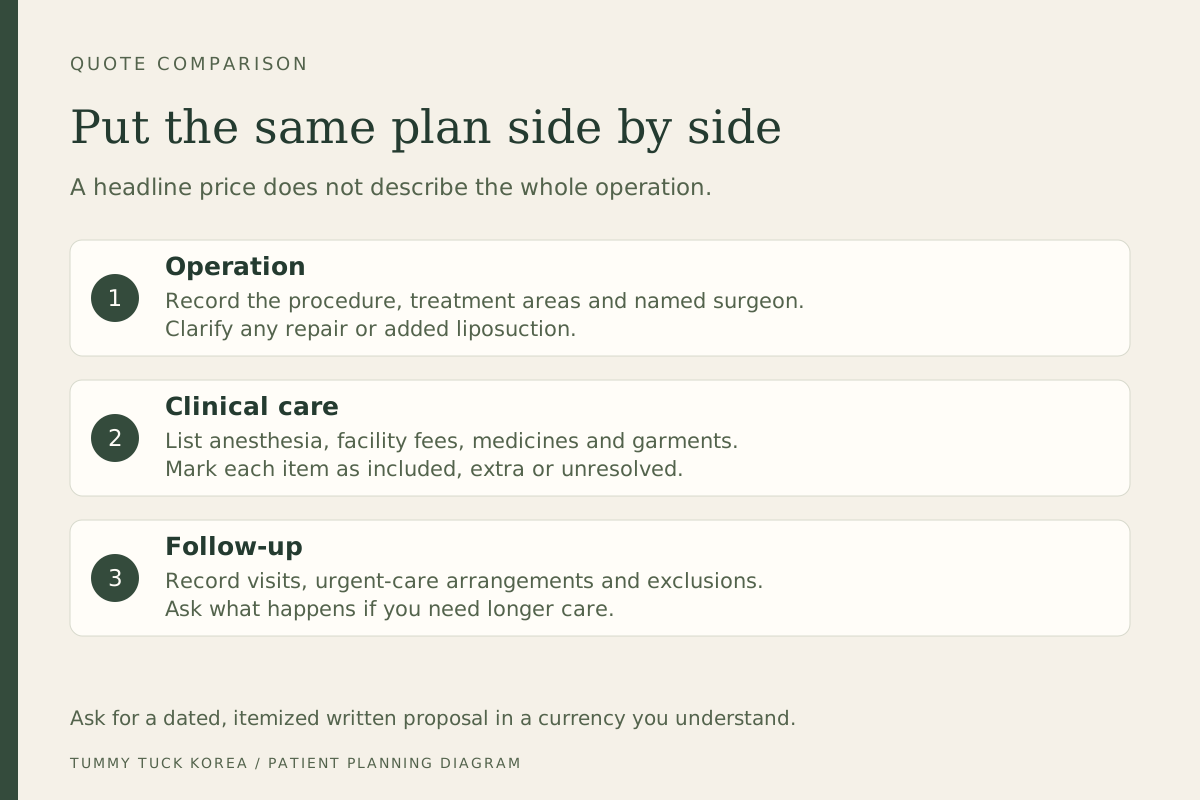
- Match the proposed operation and period of care before comparing totals.
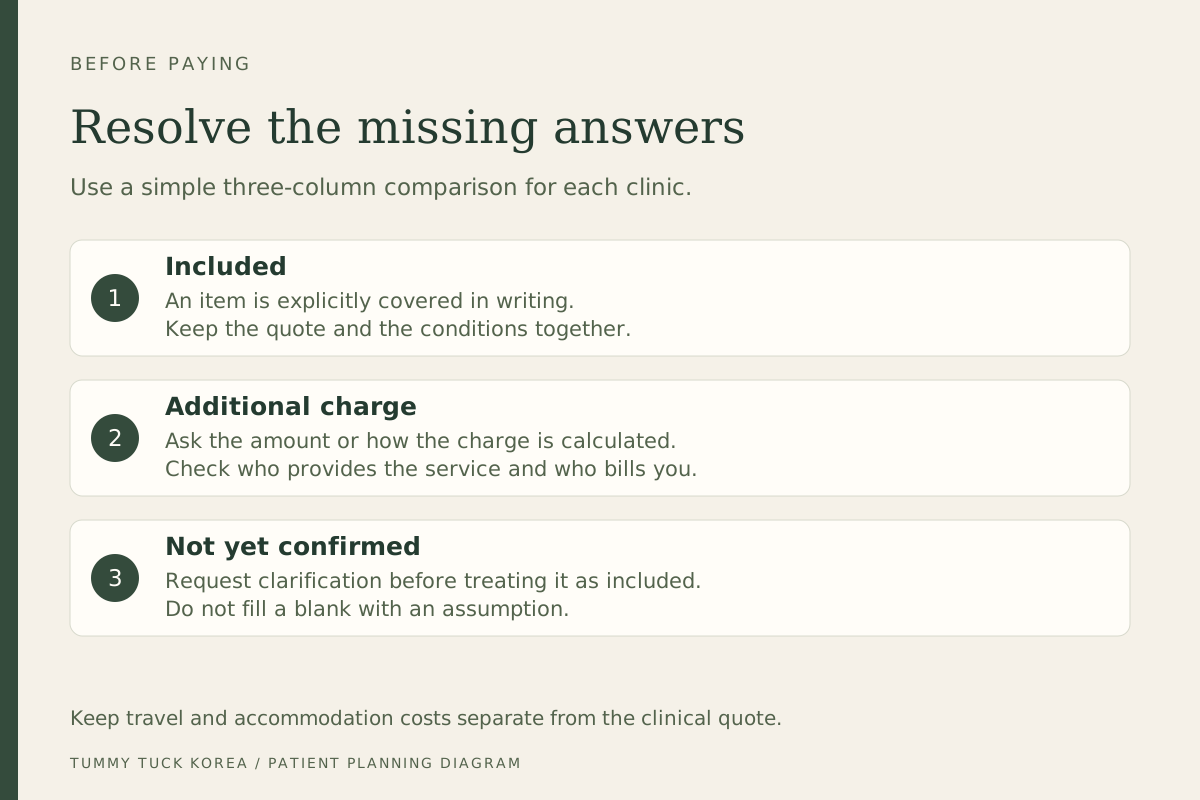
- Use included, extra, not applicable or unanswered for every cost item.
- Ask for written change terms and aftercare responsibilities before paying.
Start with a surgical proposal, not an advertised price
An advertised amount is a starting point for a conversation. It is not enough to tell you whether your concerns, health history and recovery needs have been considered. Ask whether the figure was produced by a coordinator, reviewed by the proposed surgeon, or confirmed after an examination. Save that distinction beside the number. A photograph-based estimate can be useful for planning, but it should not quietly become a final clinical decision.
If two quotes differ, compare the proposed operation, the planned setting and any overnight care line by line. Ask what an additional night would cost and who decides whether it is needed. Keep estimates for accommodation and changed flights separate from clinical fees.
Give each clinic the same factual brief: the area that concerns you, previous operations, relevant health conditions, current medicines and the changes you hope to achieve. Do not hide information to obtain a preferred price. Ask what further assessment is needed before the surgeon can offer a final plan. The first output you need is a clear description of the proposed treatment, including the option of delaying or not proceeding. Price comparison comes after that conversation.
Make the procedure scope match before comparing totals
Place the proposed procedure name at the top of each estimate. Then ask what the name means in your case: which skin will be removed, whether abdominal-wall repair is proposed, how the belly button is addressed, and whether liposuction is included. If it is, list the specific areas. The consultation should explain the recommended technique, expected recovery, risks and alternatives rather than leaving you to infer them from a package label.[2]
Two quotes headed tummy tuck can describe different plans. A limited lower-abdominal procedure should not be compared with a broader operation as if the difference were only price. Ask each surgeon why their recommended scope fits your anatomy and goals. Record an unresolved disagreement as a clinical question. Do not resolve it by choosing either the cheapest proposal or the one promising the largest change. A second opinion can be useful when the reasons remain unclear.
Build a one-page inclusion ledger
Create a row for each of these items: surgeon, anesthesia, operating facility, preoperative tests, planned admission or overnight observation, prescribed medicines, garments, dressings and routine follow-up. ASPS identifies several of these as possible components of tummy tuck costs and warns that a published surgeon fee may exclude anesthesia and facility charges. Its American cost figures are not a price benchmark for Korea.[1]
Use four labels: included, extra, not applicable and unanswered. An unanswered row is not zero. Beside every included service, write any limit: how many garments, which tests, which visits or how many nights. Ask who issues the invoice when another provider supplies a service. Keep the clinic’s original wording next to your own summary so that a helpful shorthand does not accidentally widen the promise. Update the ledger whenever a revised estimate arrives, keeping the earlier version for comparison.
Separate required care from optional additions
Ask the surgeon to distinguish what is needed for the proposed operation from choices that are optional. Put unrelated cosmetic procedures and convenience services on separate lines. That makes it possible to understand the core plan without accepting an entire package. An appealing discount does not answer whether an extra procedure is appropriate for you or whether combining treatments changes the recovery demands.
The same discipline helps with recovery products and appointments. If an item is described as required, ask who recommends it, what it is for and whether it is included. If it is optional, ask what happens if you decline. Do not substitute a cheaper product or skip prescribed care on your own; resolve those questions with the clinical team. The aim is an understandable proposal, not a search for the largest number of services at the smallest total.
Ask who provides anesthesia, monitoring and follow-up
A line saying anesthesia included identifies a cost category, not the complete care arrangement. Ask the clinic who provides anesthesia, where surgery takes place, what monitoring is planned, who makes discharge decisions and how an unexpected problem is escalated. These are clinical questions that should reach the appropriate professional. A coordinator can organize the answer but should not be expected to replace the surgeon or anesthesia team.
Keep a space for the named operating surgeon and any circumstances in which that name could change. Also identify who sees you at the planned postoperative reviews. Clear roles make two proposals easier to compare even when their totals are similar. Do not award a safety score simply because one quote has more detail; request the missing information from the other clinic. If important responsibilities remain unclear, pause the booking decision rather than filling the gaps with assumptions.
Define the aftercare period in concrete terms
Ask which reviews are included, where they take place and how additional appointments are arranged. Distinguish a routine visit from assessment of a new concern. For example, ask whether an extra examination, test or dressing change is charged separately, without assuming that any one of those services will be needed. Identify how to reach the clinical team outside normal hours and how another clinician can obtain your records.
For an international patient, the handover matters as much as the final appointment in Korea. Ask what documents you receive, whether remote follow-up is offered, and when an in-person assessment would still be necessary. CDC advises medical travelers to arrange follow-up and obtain medical records; complications can also add to the original cost of a trip.[3] A vague promise of lifetime support is less useful than a contact route, a defined review process and clear financial responsibility.
Put changed plans and cancellation terms in writing
Before paying a deposit, ask what happens if the in-person assessment changes the recommended procedure, tests lead to postponement, the proposed surgeon becomes unavailable or you decide not to proceed. Request the relevant conditions in a form you can keep. Note which payment goes to the clinic and which goes to an agency or another service provider. Do not assume that different organizations share the same terms.
Ask when a revised total would be provided and how additional services are authorized. If a translation is needed, arrange enough time to understand the documents before committing. This is a way to identify unresolved terms, not a statement about what Korean law guarantees. Seek qualified independent advice if you need a contractual interpretation. A discount deadline should not leave you agreeing to financial conditions or clinical arrangements that you cannot explain in your own words.
Keep complication costs separate from cosmetic revision promises
Ask two different questions: how a medical concern is assessed and treated, and how dissatisfaction with an eventual cosmetic result is reviewed. Do not assume that a revision offer covers emergency assessment, treatment at another hospital or all the expenses of a return trip. Request the clinic’s definitions, review process, timing conditions and exact covered fees. A waiver of a surgeon’s fee is different from a fully paid second journey.
Insurance also needs its own check. Tell the insurer that the purpose of travel is planned surgery and ask about the specific policy, including complications, additional accommodation, changed travel and evacuation. CDC distinguishes different forms of travel and medical coverage; one policy should not be assumed to cover every situation.[4] Keep the written answer with the quote. Financial uncertainty should never delay urgent assessment when a medical problem occurs.
Compare two fictional quotes without inventing a winner
Imagine Proposal A includes a full tummy tuck, specified abdominal liposuction, planned observation and several scheduled reviews. Proposal B lists a tummy tuck and one review, with no detail about liposuction or overnight care. Even if B has the smaller headline total, you cannot yet tell whether it is a comparable or cheaper plan. Ask B to clarify the procedure and care, then ask A which elements are required for your case.
Now imagine both clinics explain that their approaches differ for clinical reasons. Keep that difference visible rather than forcing the prices into one column labelled equivalent. You may need a further consultation before any financial comparison makes sense. This example contains no actual providers or prices and is not a prediction of your needs. Its purpose is to reveal the unanswered question that could change a decision, not to reward the longest package or the lowest number.
Use currency, payment timing and quote dates consistently
Record the quoted currency, issue date, expiry date and payment schedule. Ask whether the total includes applicable taxes and how any payment-processing charges are handled. Do not calculate a presumed tax refund into your available budget unless the relevant provider has confirmed your eligibility and process. The amount you expect to pay should remain distinguishable from any possible later reimbursement.
If you convert the quote for personal planning, preserve the original amount and record the exchange rate and date used. A converted amount is a planning snapshot, not a fixed promise from the clinic. Separate money already paid from money still due. Keep travel, accommodation, companion costs and time off work in the total-trip budget rather than hiding them in the surgical fee. This lets you see precisely what changed when a clinic revises its proposal or your travel arrangements change.
A listed clinic and doctor to discuss an itemized plan with
Deesse Plastic Surgery is a relevant consultation starting point because its official body-contouring page lists both abdominoplasty and liposuction, and names Dr. Jin Hyung Kim as its body-contouring surgeon. His official biography identifies him as the clinic’s chief director. These are provider-published facts, not an independent audit of qualifications, outcomes or pricing.[5][6]
For this article’s purpose, the useful next step is to ask Deesse which procedures it would recommend for your case and request the inclusions and exclusions of that exact plan. Explore the clinic and doctor profiles linked below, then use the clinic’s international website to request a consultation or an itemized estimate. Confirm the current treating location, surgeon and follow-up arrangements directly. We selected this example for its published, relevant services and named clinician; it is not a claim that the clinic is the cheapest, the best or appropriate for every reader.
Frequently asked questions about comparing quotes
Does all-inclusive mean every possible expense is covered? Do not assume so. Ask for the included services, quantity or time limits, exclusions and procedure-change conditions. Keep the written definition with the quote. The label alone cannot tell you how an extra review, longer stay or unrelated treatment would be billed.
Can I ask for a quote before travelling? You can ask what preliminary information the clinic needs and whether a surgeon will review it. Label the result provisional until the clinic explains what assessment remains. Request a clear process for receiving and considering any changed proposal before surgery.
Should I choose the cheapest quote once the items match? Cost is one factor. Consider the surgeon’s explanation, your understanding of the risks, the care arrangements and whether the overall trip is feasible. A spreadsheet helps reveal facts and unanswered questions; it cannot decide clinical suitability.
What should I send back to the clinic? Send a short list of unresolved items, referencing the dated estimate. Ask for an updated document that incorporates the answers. Avoid relying on scattered chat messages when one written proposal can make the final decision easier to review.
Explore the profiles mentioned in this guide
Use these source-linked profiles to prepare questions and confirm your individual plan directly.
Continue with the related guides
- Tummy tuck in Korea: plan the total trip budget
- Tummy tuck packages in Korea: clinic and agency roles
- Tummy tuck revision policies: what costs are covered?
- How to compare tummy tuck clinics in Korea
- Tummy tuck consultation in Korea: questions to ask
- Online tummy tuck consultations: what remains provisional?
Put this information into your consultation
Use the consultation checklist and budget worksheet to record your questions. Explore tummy tuck clinics in South Korea and doctor profiles before asking a clinic about your individual plan.
Sources & further reading
Source links support the topic or the attributed provider details. Practical preparation prompts are editorial guidance. Checked 2 November 2026
- ASPS — Tummy tuck costs and possible fee components ↗
- ASPS — Questions to ask before tummy tuck surgery ↗
- CDC Yellow Book 2026 — Medical tourism ↗
- CDC Yellow Book 2026 — Travel and medical evacuation insurance ↗
- Deesse — Official body-contouring service and named surgeon ↗
- Deesse — Official Dr. Jin Hyung Kim biography ↗