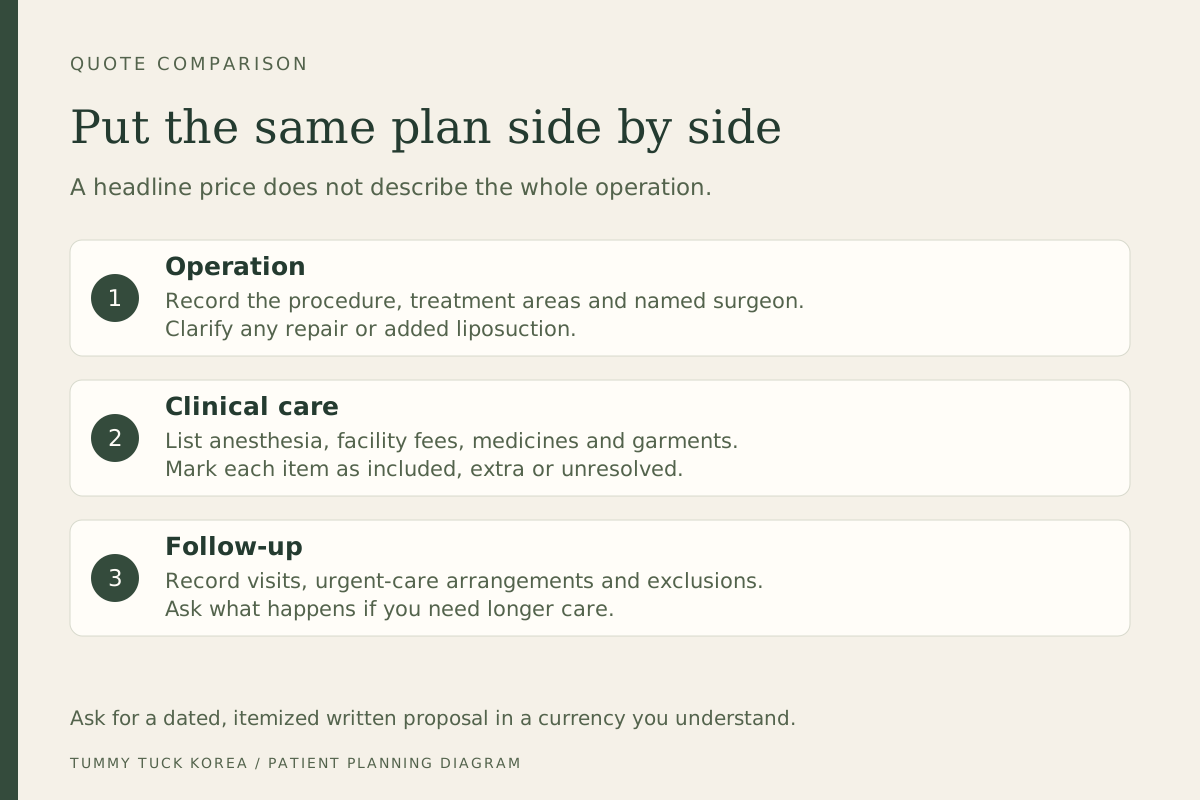
- Use actual quotes rather than a national price guess.
- Include support, time away, and payment timing.
- Keep a separate contingency scenario.
Which medical and travel costs belong in your budget?
Create one section for clinical fees and another for travel and living expenses. In the medical section, record the proposed operation, tests, anesthesia, facility, planned admission, prescriptions, garments, and follow-up. Use the clinic’s written estimate and mark items that have not been confirmed. In the travel section, include flights, local transport, accommodation, food, communication, and a companion if planned. ASPS explains that a surgical fee may be only part of the total medical price; use that as a reason to ask for detail, not as a price estimate for Korea. Keeping the sections separate makes changes easier to trace when the surgical plan or travel schedule changes.
Record currency and payment timing
Use the currency quoted by the provider and note when payment is due. If you convert the amount for your own planning, record the exchange rate and date rather than treating the converted amount as fixed. Ask your payment provider about relevant fees and use its current information. Separate a refundable amount from money that may be committed under the stated terms. Do not treat a deposit as proof that the final procedure and total are settled. Ask what happens if an in-person assessment changes the plan. A cash-flow view is useful: identify what must be paid before travel, during the admission, and after discharge so you are not surprised by timing.
Add the cost of support and time
Include the practical expenses that are easy to overlook because they are not on the clinic invoice. These may include your companion’s travel, childcare, pet care, help at home, and income not earned while away. Use your own circumstances rather than a generic recovery assumption. Ask the surgeon what restrictions are relevant to your work and responsibilities, then make a provisional support estimate. If the person helping you also needs time away from work, include that in your discussion. A budget that balances only when everyone recovers immediately and no support is needed is not a useful basis for deciding whether the trip is affordable.
Create a contingency scenario
Make a second version with extra accommodation, a changed flight, and additional support. Do not assign a fabricated probability or imply that a fixed reserve covers every possible complication. Ask the clinic which additional medical services could be charged and ask your insurer which expenses, if any, are covered. Keep uncertain coverage visible. Consider whether you would be able to obtain necessary care if the cost exceeded your planned reserve. If not, the plan may need to be postponed or redesigned. Contingency planning is not pessimism; it is a way to prevent a financial deadline from dictating a medical decision during recovery.
Review the budget as a decision document
Before paying, check every line for a source, a date, and a status: confirmed, estimated, or unanswered. Remove duplicated costs from package quotes and add missing exclusions. Compare your total with the amount you can comfortably commit, including the support you need after returning home. Keep a separate list of assumptions such as one companion or a particular accommodation duration. If an assumption changes, update the relevant rows rather than rebuilding the entire budget from memory. The result should explain where the money goes and what remains uncertain. It should not be presented as a guaranteed all-in price or a prediction of the cost of your medical recovery.
Use assumptions you can change
An illustrative budget may assume one room, one companion, and a return flight on a particular date. Put those assumptions at the top of the sheet rather than burying them inside totals. If the companion leaves earlier or the stay extends, you can then see which lines change. Keep a separate column for money already paid and money still due. Do not count a potential refund as available cash until its status is confirmed. If the clinic quote changes, preserve the original for reference and make clear which version is current. This structure helps you understand the financial effect of a changed plan without pretending to forecast medical events. A useful budget remains understandable to the person helping you if you are unavailable to explain every calculation.
Put this information into your consultation
Use the consultation checklist and budget worksheet to record your questions. Explore tummy tuck clinics in South Korea and doctor profiles before asking a clinic about your individual plan.
Sources & further reading
Source links support the topic or the attributed provider details. Practical preparation prompts are editorial guidance. Checked 20 October 2026