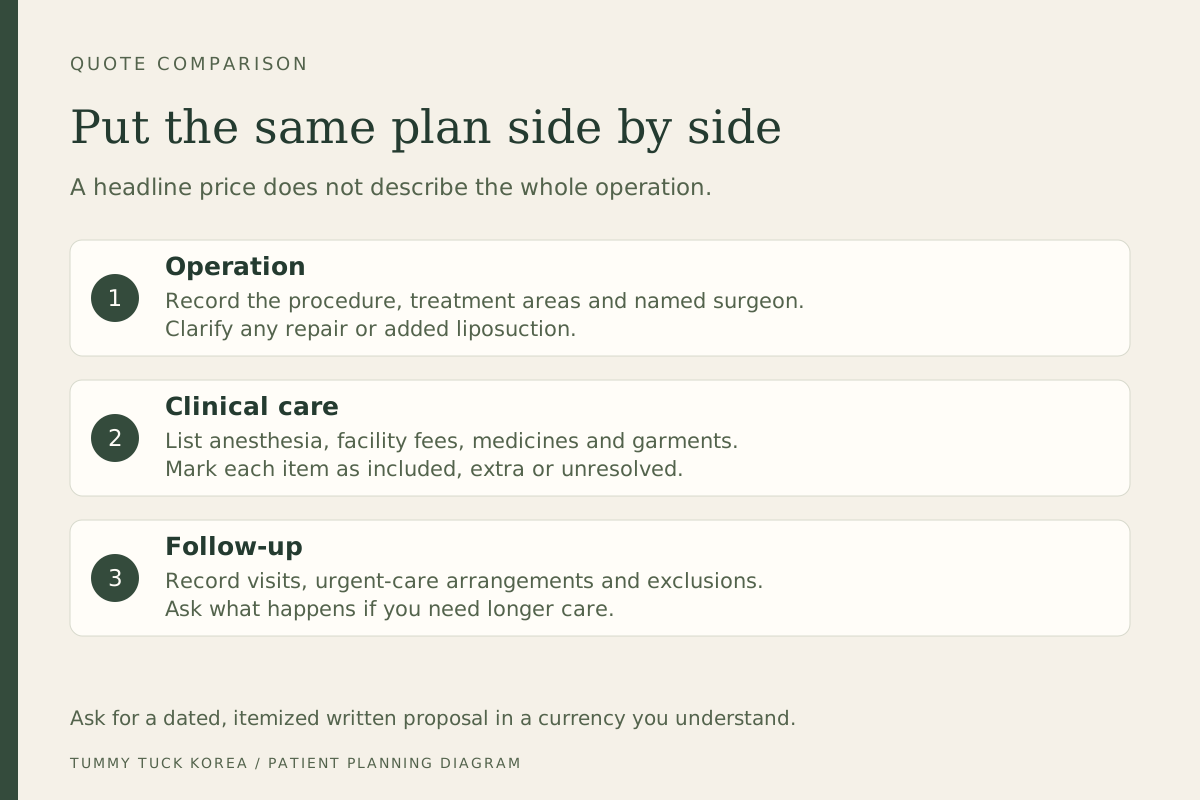
- Compare named surgeons, branches, and actual procedures.
- Assess aftercare and communication as separate parts of care.
- Keep reviews distinct from verified clinical facts.
Which provider and procedure are you comparing?
Record the legal clinic name, branch, proposed surgeon, and the source confirming that abdominoplasty is offered. A general plastic surgery homepage is not enough to establish every procedure. Match the location in the estimate to the location in your research. If a brand has several branches or surgeons, ask which one will provide your care. Keep the international website separate from the Korean source so you can see where each claim comes from. Do not let a directory listing stand in for a current clinical confirmation. The first comparison question is whether you are evaluating the same identifiable service, not which website looks most impressive.
Compare the explanation of your case
Ask each surgeon why they recommend a particular approach and what alternatives they considered. Record the proposed incision, additional procedures, important limitations, and reasons to postpone. If the recommendations differ, ask about the reasoning rather than choosing the plan that promises the largest change. You may need another consultation to understand the difference. A useful comparison preserves uncertainty: one plan may depend on an examination that has not yet occurred. Label it provisional. Avoid turning a coordinator’s preliminary message into a surgeon’s final recommendation. Clinical reasoning, when explained clearly, is more useful than a slogan about advanced technology or natural results.
Compare the care system
Use separate rows for anesthesia arrangements, planned admission, emergency transfer, routine follow-up, language support, and care after returning home. Ask who is responsible for each. A luxury waiting room or a convenient hotel package does not answer those questions. Medical Korea’s accreditation program can be checked when a clinic claims participation, but the exact institution and current status should match. Accreditation and registration are not interchangeable labels. Keep facility status separate from the surgeon’s qualifications. Ask what documents will be provided at discharge and how another clinician can contact the team. These details make the patient journey more concrete than a broad promise of comprehensive care.
Use reviews and images cautiously
Patient stories can suggest questions about communication, logistics, and expectations, but they do not establish your likely result. Ask whether reviews concern the same surgeon, procedure, branch, and period. Look for specific descriptions rather than only star ratings. A small or selectively presented set of stories cannot be treated as a complication rate. Before-and-after images should be discussed in context, including the procedures performed and timing. Avoid borrowing a platform’s popularity metric as a clinical quality score. Keep anecdotal information in a separate section from verified credentials and written care terms. This makes it easier to value patient experience without asking it to prove more than it can.
Create a decision matrix without a false winner
Choose the factors that matter to you and give each a plain-language status: adequately answered, needs clarification, or does not meet my needs. Include the surgeon’s explanation, support arrangements, travel feasibility, total budget, and comfort with communication. Add a source or document beside every factual entry. Do not calculate a numerical winner from unknown or incomparable data. Instead, identify the unanswered question that could change your decision. Send a focused follow-up to the relevant clinic. If the most important items remain unclear, it is reasonable to pause. The matrix should support a thoughtful choice, including not proceeding, rather than manufacture certainty from marketing material.
Avoid turning missing information into a ranking
Suppose one clinic publishes a detailed doctor biography and another provides only a short introduction. The difference tells you about available information, not automatically about surgical skill. Ask the second clinic for the missing details and assess the response. Conversely, a long profile may contain claims that still need checking. In your matrix, distinguish not published, requested, and confirmed rather than scoring all missing facts as either good or bad. Apply the same approach to follow-up terms and international support. This makes the comparison fairer and more useful. The purpose is to discover whether the information needed for your own decision can be obtained, while avoiding an unsupported public ranking based on website completeness, advertising style, or the number of photographs displayed. Keep the comparison small enough to maintain accurately; a few well-investigated options are more useful than a large list whose key details remain unchecked.
Compare the complete care journey
Explore these related questions as you discuss your individual plan with your care team.
Put this information into your consultation
Use the consultation checklist and budget worksheet to record your questions. Explore tummy tuck clinics in South Korea and doctor profiles before asking a clinic about your individual plan.
Compare published clinic details
Use the clinic comparison tool to place two profiles side by side. Published information is a starting point, not a ranking or confirmation of current availability; ask each clinic about the named surgeon, complete quote and aftercare.
Sources & further reading
Source links support the topic or the attributed provider details. Practical preparation prompts are editorial guidance. Checked 20 October 2026