- Ask what revision means in the written policy.
- A waived surgeon fee may not cover the full journey.
- Keep urgent medical concerns separate from cosmetic review.
What does the clinic mean by a revision?
Ask whether the policy concerns a cosmetic adjustment, treatment of a complication, scar management, or another operation. These situations may have different pathways. Request examples of what the clinic considers within scope and what it excludes, without assuming an example predicts your own outcome. Ask who assesses the concern and whether the original surgeon must perform any further procedure. A statement such as revision included is too broad to compare reliably. Your goal is to understand the process for review and the possible costs, while recognizing that the appropriate timing and treatment of a concern require clinical assessment. Do not seek an automatic operation in place of that assessment.
Separate review from treatment
Find out whether an initial review can happen remotely and when an in-person examination is necessary. Ask what information the surgeon needs, how appointments are arranged, and whether the clinic charges for the review. Request the expected communication route if you live in another country. A remote conversation may help organize the next step, but do not assume it can settle every issue from photographs. Ask how urgent concerns are handled separately from dissatisfaction with appearance. Keep your symptoms and timeline factual when communicating. The clinical team should decide what needs prompt assessment; a revision-policy discussion should not delay care for a possible complication.
List every potential expense
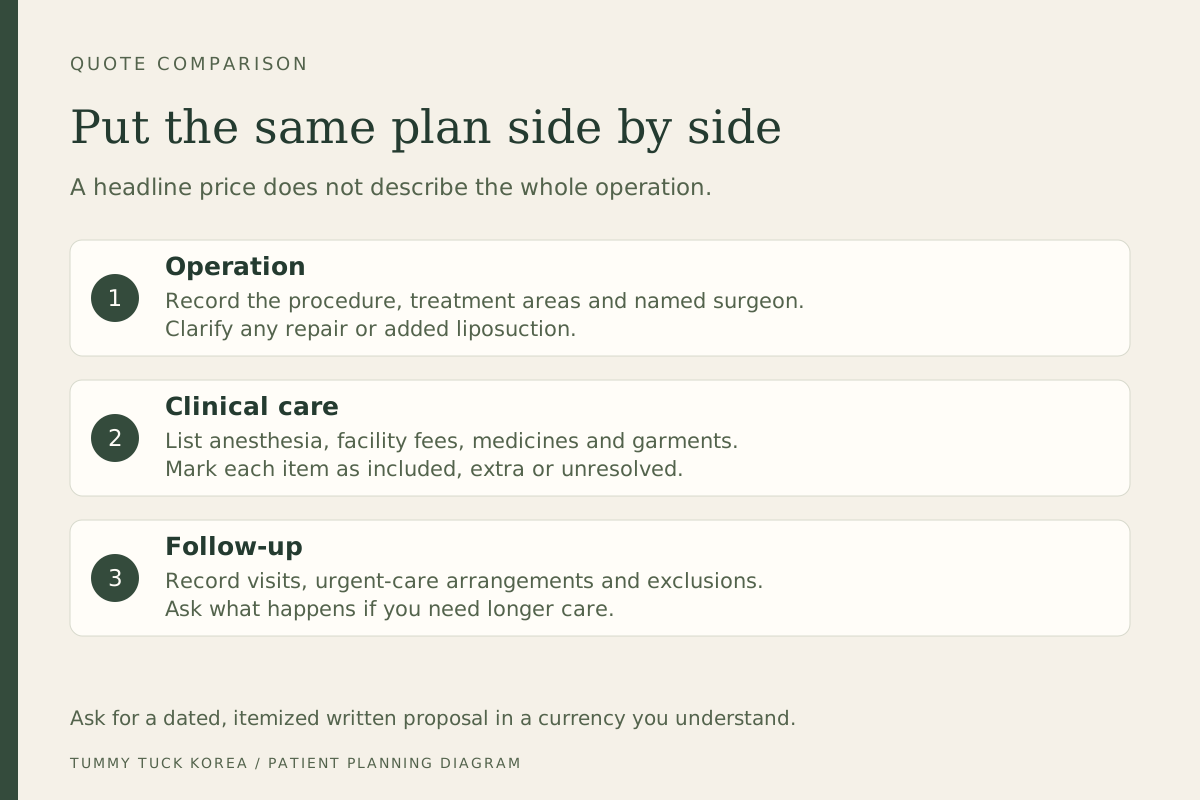
Ask specifically about the surgeon’s fee, anesthesia, facility, tests, prescriptions, garments, aftercare, accommodation, and travel. Write down whether each is covered, discounted, excluded, or undecided. Ask if the policy changes when another hospital or surgeon is involved. If the clinic offers only a waiver of its own fee, preserve that wording rather than summarizing it as free revision. Add the cost of time away from work and support at home to your personal budget. These are not necessarily reimbursable expenses, but they affect your ability to use the policy. An overseas revision offer may be difficult to act on if the practical cost of returning has not been considered.
Understand the timing and conditions
Ask when concerns can be reviewed, whether the policy has a time limit, and what follow-up attendance or documentation it requires. Do not interpret a policy deadline as a medical recommendation to operate before healing has been assessed. Ask how the clinic handles a disagreement about the result or proposed remedy. Request the formal complaints route and the legal entity responsible for the agreement. This guide does not state what Korean law requires or how a dispute would be decided. If the financial or contractual stakes are significant, seek appropriate independent advice. Keep copies of estimates, consent documents, photographs you have authorized, and relevant communications in an organized folder.
Use a policy comparison worksheet
For each clinic, summarize the definition of revision, review process, time conditions, covered fees, excluded fees, required travel, and route for disagreement. Place the original wording beside your summary. Highlight any term that depends on the clinic’s discretion and ask how that decision is made. Then consider a hypothetical return visit: who schedules it, who pays the flight, who supports you, and who provides later follow-up? This is a budgeting exercise, not a prediction that revision will be necessary. A useful policy is one you understand well enough to explain accurately. If a promise cannot be translated into concrete steps and costs, keep it marked as unresolved.
Distinguish a promise from a usable process
An illustrative policy might say that the clinic supports patients who are dissatisfied, yet give no contact, assessment method, or description of costs. Ask how that support begins and what happens next. Another policy may list a clear review process but leave the decision about further treatment to the surgeon. That is different from promising an automatic second operation. Preserve those distinctions in your comparison. Ask how the policy works for a patient who cannot return immediately and whether records can be shared with a local clinician. Do not assume an overseas visit is the only or the right response to every concern. The immediate clinical need and the financial policy should be considered separately, with a clear route to assessment before discussing any elective corrective procedure.
Put this information into your consultation
Use the consultation checklist and budget worksheet to record your questions. Explore tummy tuck clinics in South Korea and doctor profiles before asking a clinic about your individual plan.
Sources & further reading
Source links support the topic or the attributed provider details. Practical preparation prompts are editorial guidance. Checked 20 October 2026