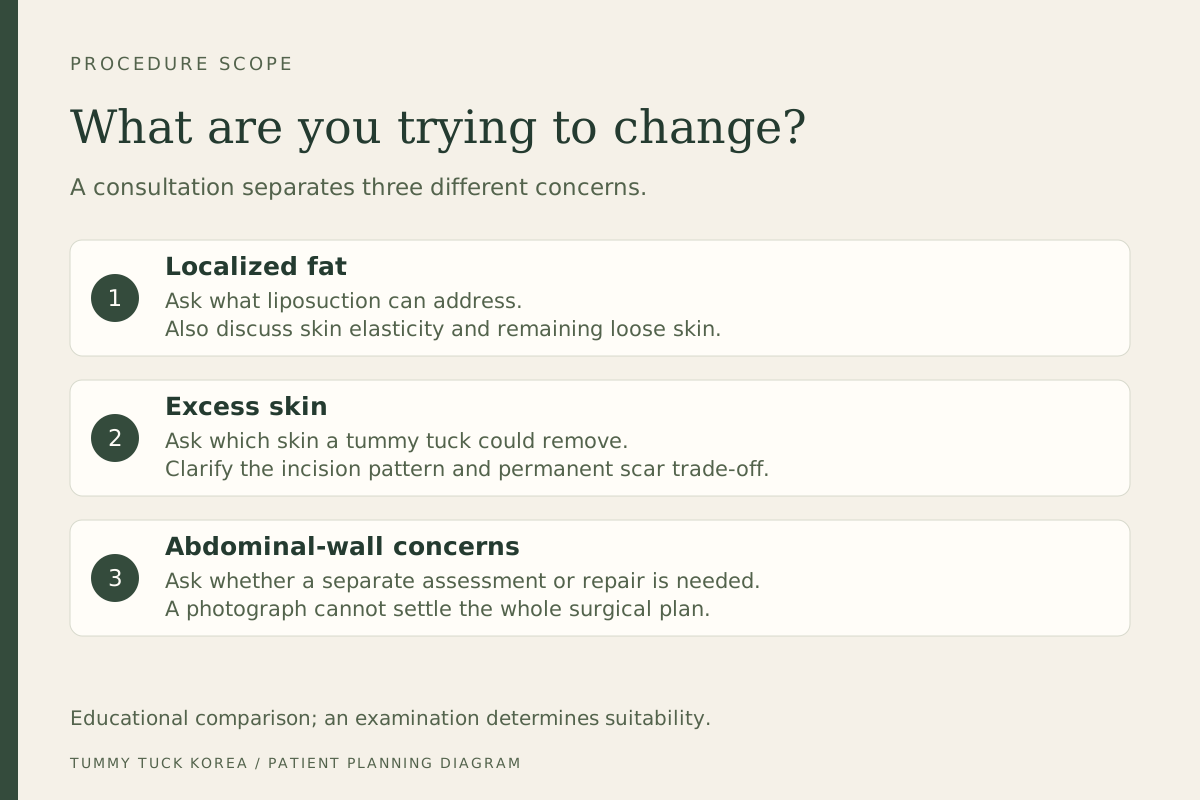
- Identify whether the main issue is skin, fat or abdominal-wall laxity.
- A smaller incision does not guarantee the right correction.
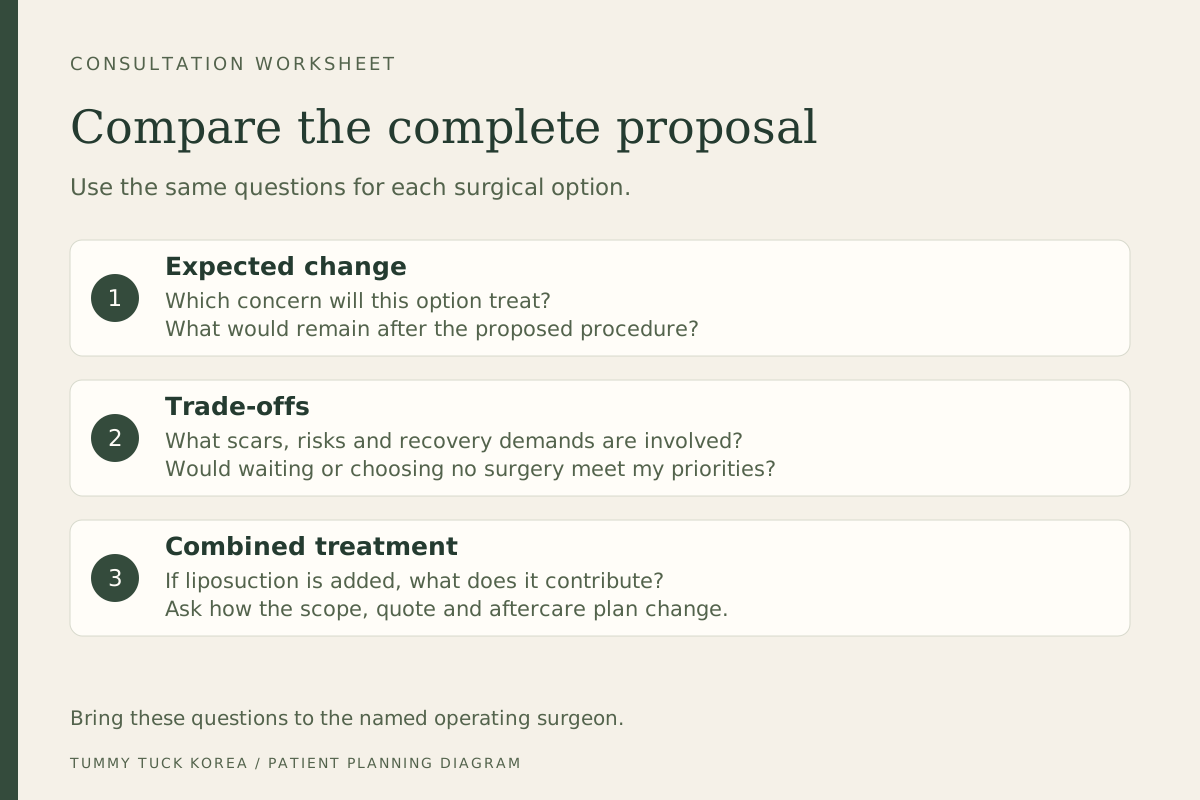
- Combined treatment should give each component a clear purpose.
Start with the change you actually want
A useful comparison begins with a sentence about everyday life: “I want less skin folding over my waistband,” “I want the bulge at my sides to be smaller,” or “I want to understand why my abdomen projects when I stand.” These are different concerns, even when they appear in the same photograph. Write your main concern first and any secondary wishes underneath. That order helps a consultation stay focused when several procedures are offered.
Ask the surgeon to explain what contributes to each concern and what the proposed operation would leave unchanged. You do not need to diagnose your abdomen or choose a surgical technique before attending. In particular, a pinch test at home cannot establish whether skin removal, fat reduction or abdominal-wall assessment is appropriate. A physical examination is the point at which a preliminary idea becomes an individualized proposal. If an online consultation produces a recommendation, ask which parts remain provisional until that examination.
What each procedure is designed to address
Liposuction removes selected deposits of fat through small access incisions. Skin elasticity matters because the covering skin must adapt to the changed contour. A tummy tuck removes excess skin and fat and can include repair of weakened or separated abdominal-wall tissues. The procedures therefore answer different anatomical questions rather than representing small and large versions of the same operation. Neither is a substitute for weight management. [1][2][3]
For your comparison sheet, use three headings: the area being treated, the tissue being treated and the concern expected to remain. Ask the clinician to fill these in for liposuction alone and for abdominoplasty alone. This makes a vague promise of a “flatter stomach” easier to discuss. You may discover that the smaller operation addresses enough of your goal, or that it leaves the very fold that concerns you most. Either finding is useful before committing to a deposit.
A smaller scar is a preference, not a diagnosis
A full tummy tuck usually leaves a long lower-abdominal scar and a scar around the navel; liposuction uses smaller access incisions but still leaves scars. Abdominoplasty can also involve different incision patterns depending on the planned excision. Discuss the exact proposal instead of assuming every tummy tuck has the same footprint. [2][3]
Decide how you feel about a permanent scar in exchange for removing loose skin. Some people would rather accept remaining laxity than undergo a larger operation. Others would find little value in paying for fat reduction if the skin fold stayed. There is no correct preference that a clinic should persuade you to adopt. Ask to see healed examples that show the incision clearly, including the sides, rather than only frontal photographs in underwear. Request the time since surgery and whether additional procedures were performed. Those questions make examples more informative without turning another person's outcome into a prediction for you.
When both procedures appear in one plan
A surgeon may propose liposuction alongside a tummy tuck when separate concerns justify each component. For example, the discussion might distinguish a skin-removal goal from a fat-contouring goal. Do not assume that all abdominal or flank liposuction is included in the words “tummy tuck,” or that a package called “360” defines the same boundaries at every clinic. Request a drawing and a written list of the included areas.
Ask two counterfactual questions: what would the result be expected to look like without the added liposuction, and what would it look like without the skin excision? Then discuss whether one operation or staged treatment better fits your health and priorities. The additional expense, follow-up and recovery demands should have a clear purpose. You are allowed to decline an optional area even when a promotional bundle makes it seem financially attractive. A combined proposal needs one coherent aftercare plan covering everything treated, not separate marketing descriptions that never explain the whole recovery.
What the examination and health review should settle
ASPS describes appropriate tummy-tuck candidates in terms of health, stable weight, realistic expectations and not smoking. Its liposuction guidance additionally emphasizes firm, elastic skin and muscle tone. These are starting points for assessment, not a self-screening test or a promise of eligibility. [1][4]
Bring your previous operation history, current medicines and supplements, allergies and relevant medical conditions. Explain recent weight change, pregnancy plans, nicotine use and the support available during recovery. Do not stop prescribed medicines to appear ready for surgery; ask the treating team and prescriber to coordinate any changes. If you are asked to provide photographs before travelling, use the clinic's secure process and clarify how those images will be used. Tell the team what you cannot manage practically, such as lifting a child alone or extending leave at short notice. A technically possible procedure may still be poorly timed for your circumstances.
Compare recovery by tasks, not a package calendar
Both operations require recovery planning. The NHS notes that the time needed after liposuction depends partly on the areas treated and the person's work; abdominoplasty is major surgery with a substantial recovery commitment. Published timelines are general information, not clearance to travel or resume your particular duties. [2][3]
List the tasks you need to perform: getting out of bed, climbing stairs, preparing meals, travelling to appointments, commuting, carrying luggage and caring for dependants. Ask when assistance may be needed and which activities require the surgeon's permission. A desk job done at home differs from work involving long standing or lifting. Confirm how dressings, garments and any drains will be managed and who teaches you the instructions. For a Korean surgery trip, the date of your return ticket must not replace a clinical assessment of readiness. Leave practical room for an additional review rather than assuming the advertised minimum stay covers every possible recovery.
Understand the risks of the actual proposal
Potential problems include bleeding, infection, blood clots and adverse anaesthetic reactions with either operation. Liposuction can produce uneven contours and has other serious procedure-specific complications; tummy tuck can involve delayed wound healing, fluid collections and unfavorable scars. The NHS describes these risks and advises contacting the treating clinic promptly for severe pain or unexpected symptoms. [2][3]
Ask how the team assesses your individual risks, what warning symptoms they want reported and where you should go for urgent assessment outside opening hours. Request an explanation in language you understand. Do not settle for the statement that complications are rare without discussing what happens if you experience one. An international patient also needs to know how records will reach a clinician at home. Avoid choosing solely by which procedure sounds less invasive: the amount treated, your health and the care arrangements matter. If a complication is suspected, obtaining assessment takes priority over protecting a travel schedule or waiting for a cosmetic follow-up photo review.
Compare like-for-like costs in Korea
Ask for an itemized personal estimate after the surgical scope is clear. Record the named operation, anatomical areas, any abdominal-wall work, anesthesia, facility charges, garments, medicines and scheduled follow-up. Identify which items are included and which could be charged separately. A low advertised starting price is not comparable with a complete proposal until those details match.
Keep travel, accommodation, a companion, time away from work and possible extra appointments in a separate budget. This avoids confusing the surgeon's fee with the total financial commitment. Ask whether the estimate can change after an in-person examination and what cancellation terms apply if you decline the revised plan. Also ask who pays for additional assessment or corrective treatment. This guide does not provide a universal Korean price: different scopes of treatment and individual requirements make an unsupported single figure misleading. Use the site's quote-comparison guide for a detailed checklist once you know which operations you are comparing.
A listed clinic and doctor to consider for this discussion
VeryGood Plastic Surgery is a relevant starting point because its international body-contouring page publishes both corset abdominoplasty and liposuction services. That same page names Dr. Im Young-min as its body-contouring surgeon, and his clinic biography lists body contouring among his specialties. Both the clinic and doctor have profiles in this atlas. These are clinic-published service and affiliation statements, not an independent audit of qualifications or outcomes. [5][6]
Review the linked profiles and international website, then request a consultation comparing the options for your own anatomy. Ask Dr. Im, if he is the proposed surgeon, which concern each component treats and what his clinic means by “corset” in your specific plan. Ask for the incision and repair details rather than relying on the name. This recommendation is based on published relevance to both procedures, not a ranking or a guarantee of suitability. Confirm the operating surgeon, current availability and aftercare arrangements before booking.
Questions patients often ask
Can exercise replace either operation? Exercise can support health and fitness, but it does not perform the skin excision involved in a tummy tuck. Whether a concern warrants surgery is a separate personal and clinical decision. You may choose no treatment even when surgery could change the contour. [2]
Can I decide using photographs alone? Photographs can help communicate goals and begin an online discussion. They cannot settle every aspect of skin quality, abdominal-wall findings, health risk or operative planning. Ask what must be confirmed in person before accepting a final proposal.
Does choosing liposuction first mean I must later have a tummy tuck? No. Clarify the expected remaining concern before the first procedure and consider whether that outcome would be acceptable on its own. Do not treat a second operation as inevitable or as a guaranteed solution to dissatisfaction.
What if two surgeons recommend different approaches? Ask each to explain the anatomical reasoning, trade-offs and expected untreated concerns. Bring the written proposals to a second opinion if necessary. A difference in recommendation is a reason to understand the reasoning, not automatically evidence that one clinician is wrong. Waiting while you clarify the choice is a valid outcome.
Explore the profiles mentioned in this guide
Use these source-linked profiles to prepare questions and confirm your individual plan directly.
Continue with the related guides
Put this information into your consultation
Use the consultation checklist and budget worksheet to record your questions. Explore tummy tuck clinics in South Korea and doctor profiles before asking a clinic about your individual plan.
Sources & further reading
Source links support the topic or the attributed provider details. Practical preparation prompts are editorial guidance. Checked 2 November 2026