- Discuss the complete scar pattern with your actual clothing in mind.
- Scar location and scar healing quality are separate questions.
- Choose an operation you can accept even with a visible scar.
Where will the scar sit under my usual clothes?
Bring photographs or examples of underwear, trousers and swimwear you commonly wear. Ask where the proposed incision would sit while you stand naturally. A generic bikini-line drawing may not match your preferred clothing or body proportions. Discuss whether the ends extend toward the hips or back and whether a vertical component is possible. A marking is a plan rather than a guarantee of the exact healed position, but it can reveal misunderstandings before surgery. Patients sometimes accept a scar based on front views and later discover that the lateral portion matters more to them. Ask to see the entire predicted pattern. If a surgeon recommends a longer scar, request the specific contour benefit it permits and what a shorter alternative would leave untreated.
Can scar quality be guaranteed by good placement?
A well-placed scar can still become wider, raised, darker or more noticeable than hoped. Placement and healing quality are separate issues. Tell the surgeon about previous scars, including any that became thick or troublesome, and show them when possible. Ask whether that history affects counseling or follow-up. Do not assume that a clinic can guarantee a fine pale line because its selected photographs show one. Scar appearance changes with healing, and individual variation remains. Request examples at stated time points and in skin tones relevant to your own, without treating them as predictions. If a clinic advertises scarless surgery for an operation that removes skin through an incision, ask exactly what it means. The incision leaves a scar even when it is strategically positioned.
How does each tummy-tuck type change the scar pattern?
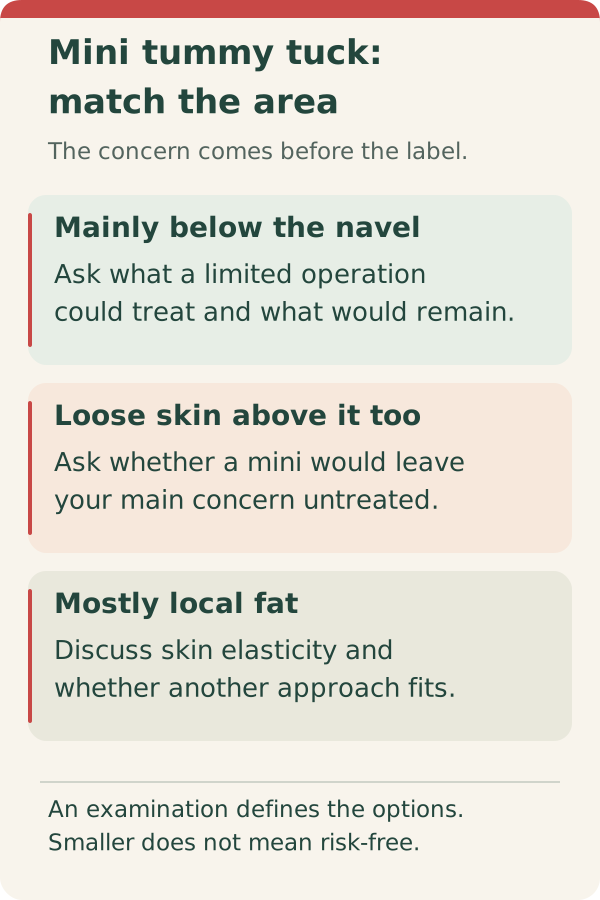
A full tummy tuck commonly includes a low abdominal scar and a scar around the navel. A mini procedure usually has a more limited pattern, while extended or fleur-de-lis approaches introduce different lengths or directions. The useful comparison is not a ranking from best to worst scar. It is whether the pattern allows treatment of the tissue that concerns you. Ask the surgeon to explain the anatomy-to-incision relationship using your own examination. If you strongly reject a vertical scar, make that preference explicit and discuss what correction remains possible. If there is a chance that the plan could change after the final examination, establish how you will review and consent to that change. A major scar decision should not be an unexpected discovery after surgery.
What follow-up or revision can improve a troublesome scar?
Ask when and how the team will assess scar healing, what care they recommend and which products or treatments should be avoided until cleared. Do not assume that an expensive scar-treatment package is automatically necessary. Request the purpose and evidence for any additional treatment, along with its timing and cost. If you return home before the scar matures, clarify who monitors it and how photographs or local examinations will be used. Ask about the clinic's policy for later scar concerns, remembering that revision aims to improve appearance rather than erase a scar. Your initial decision should still be acceptable if the scar remains visible. That makes the choice more robust than relying on a future treatment to undo a trade-off you never really accepted.
Continue with healing and expectations
Explore these related questions as you discuss your individual plan with your care team.
Put this information into your consultation
Use the consultation checklist and budget worksheet to record your questions. Explore tummy tuck clinics in South Korea and doctor profiles before asking a clinic about your individual plan.
Sources & further reading
Source links support the topic or the attributed provider details. Practical preparation prompts are editorial guidance. Checked 20 October 2026