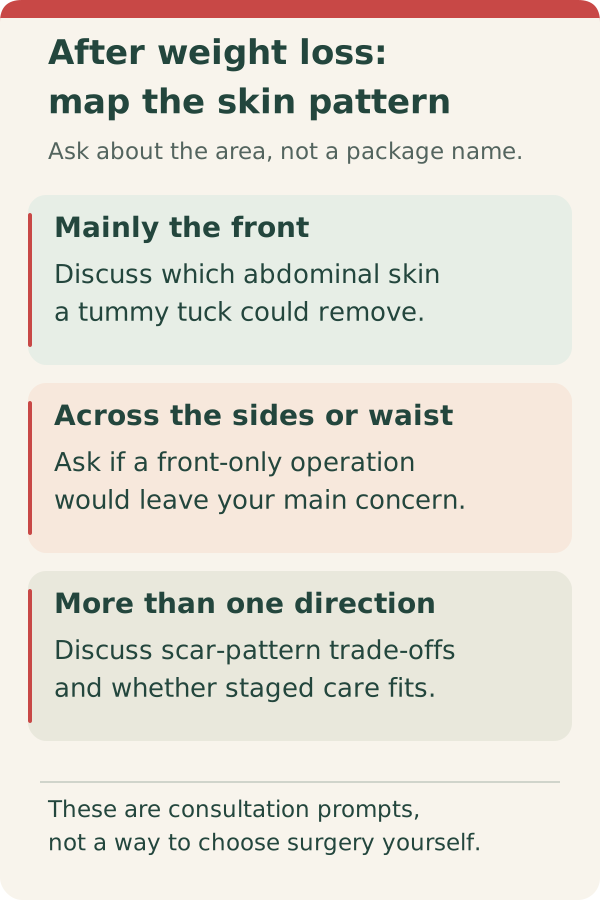
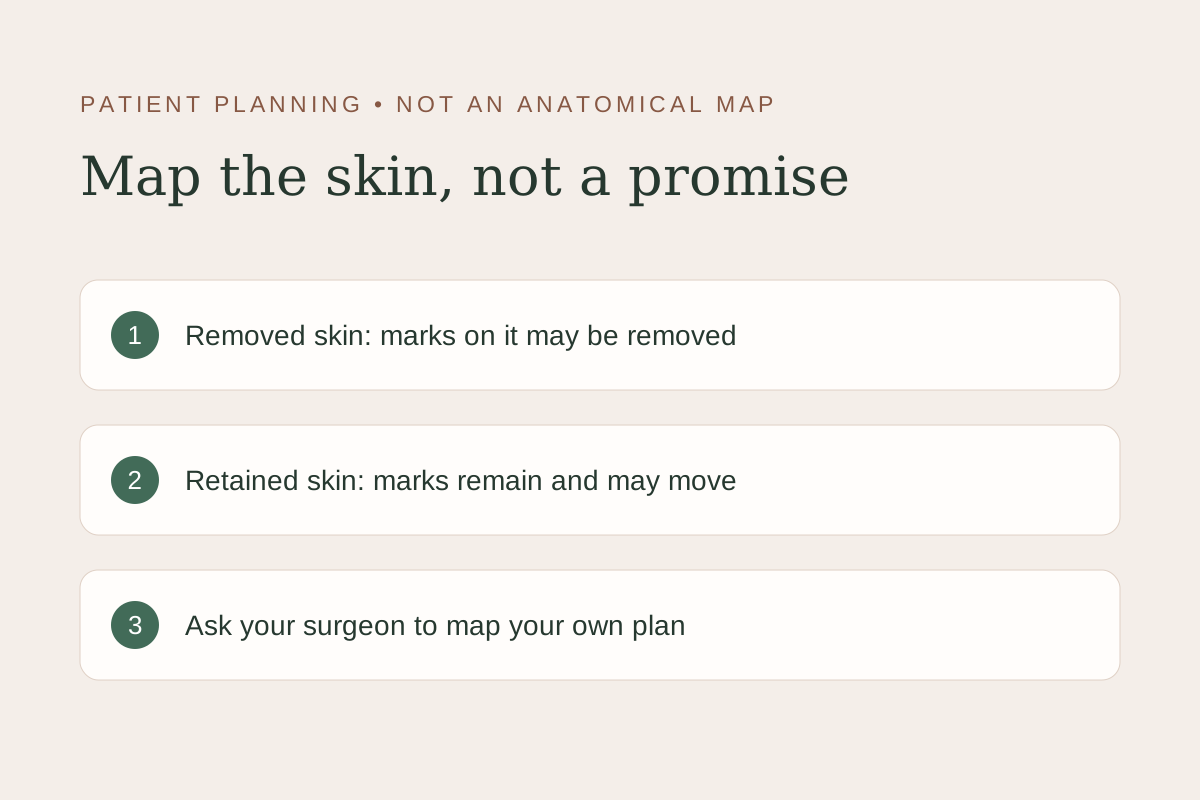
- Describe the concern before choosing its presumed cause.
- Ask which tissue each proposed treatment addresses.
- Record expected improvement and residual limits side by side.
What should I describe before choosing a diagnosis?
Tell the clinician when the concern is most noticeable: standing, sitting, bending, exercising or wearing particular clothes. Describe a fold, a localized bulge, skin rubbing or a sense of weakness rather than choosing a diagnosis yourself. If there is pain, a lump or a new change, say so directly. The clinician can then decide whether medical assessment beyond cosmetic planning is needed. Photographs requested by the clinic can support an initial conversation, but they capture only a moment and cannot show all aspects of tissue quality or function. Do not interpret a remote estimate as a final diagnosis. An in-person examination should confirm the treatment rationale and give you the opportunity to reconsider if the proposed operation changes.
Which treatment addresses skin, fat or wall laxity?
Skin removal changes redundant skin; liposuction targets selected fat beneath the skin; an abdominal-wall repair addresses a different structural issue. Fat around internal organs is not removed by a cosmetic tummy tuck or abdominal liposuction. These distinctions explain why two people with a similar silhouette may receive different recommendations. Ask the surgeon to identify the dominant contributor to your concern and the lesser contributors that will remain. A plan can be appropriate even if it does not make the abdomen completely flat, provided the limitation is understood. Conversely, a technically successful procedure may disappoint if it treats a secondary issue while your main concern remains. The consultation should connect each proposed intervention to a specific finding rather than promising general slimming.
How can I compare two different surgical recommendations?
For each option discussed, record four things: the tissue it treats, the visible change expected, the concern likely to remain and the scar or recovery burden. This creates a clearer comparison than a list of package names. If one clinician recommends liposuction and another recommends skin removal, ask each to explain their assessment of skin elasticity and the amount of residual laxity they expect. The difference may be about the desired degree of correction or tolerance for scars. Avoid assuming that the more extensive recommendation is necessarily more thorough, or that the less extensive one is automatically safer for your situation. Request reasons tied to your anatomy. A second opinion is most useful when it clarifies those reasons rather than merely supplies another price.
What result is realistic once the main contributor is identified?
Once the contributors are explained, restate your goal in terms of a change that the proposed operation can address. For example, reducing a lower fold is more specific than achieving a perfect stomach. Ask whether the expected benefit is meaningful enough to justify the operation, its risks and the practical recovery. If the main contributor is outside the scope of cosmetic surgery, discuss the appropriate clinical or lifestyle pathway rather than seeking a larger cosmetic package. For patients travelling to Korea, resolve as much as possible before nonrefundable arrangements and preserve time for the final examination. The strongest plan is one where you understand why this procedure was selected, what it leaves alone and what would make postponement the better decision.
Put this information into your consultation
Use the consultation checklist and budget worksheet to record your questions. Explore tummy tuck clinics in South Korea and doctor profiles before asking a clinic about your individual plan.
Sources & further reading
Source links support the topic or the attributed provider details. Practical preparation prompts are editorial guidance. Checked 20 October 2026