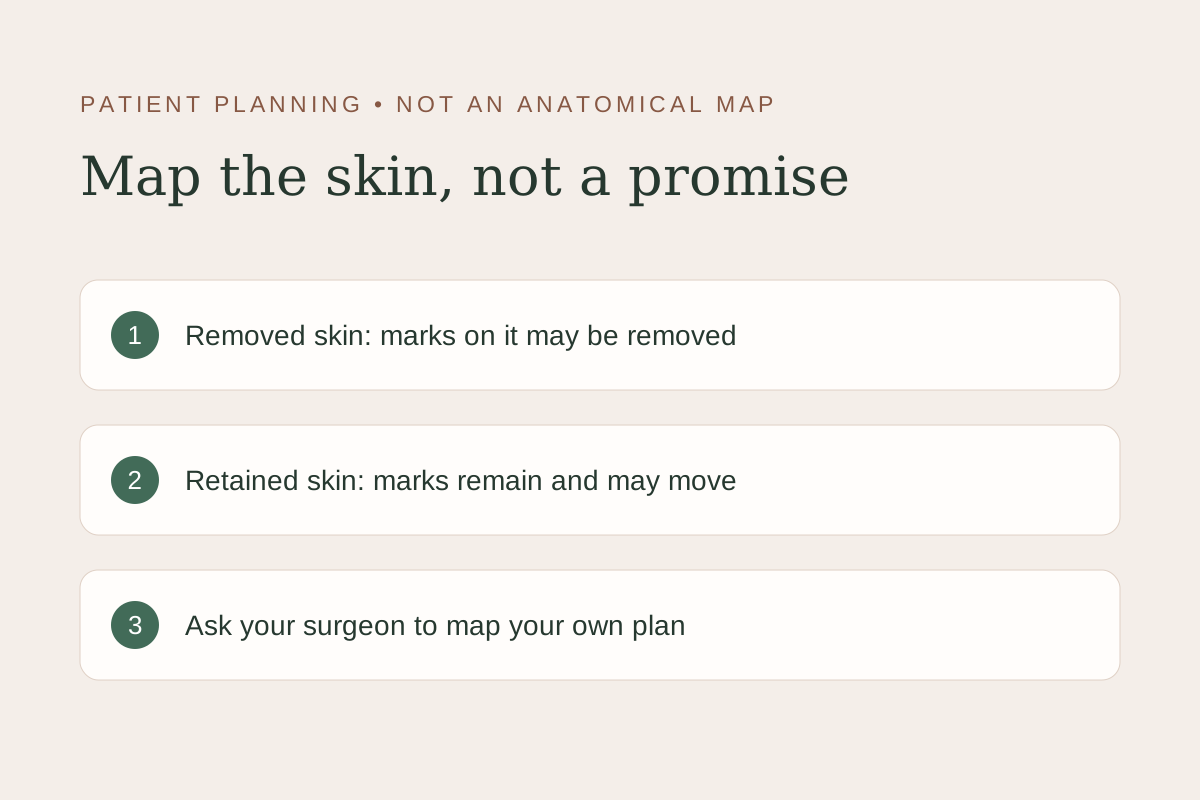
- Only marks on removed skin are removed with the operation.
- Contour improvement is different from eliminating texture or color changes.
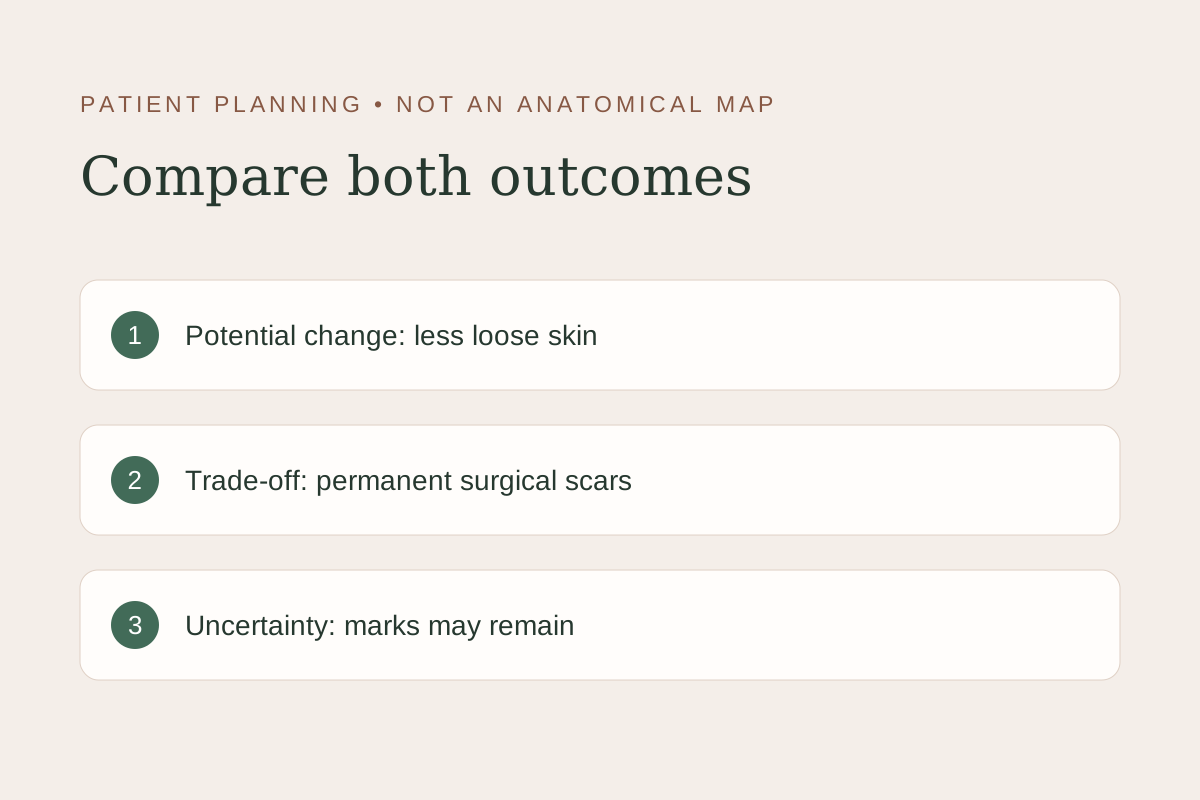
- Compare the expected result with the permanent scar trade-off.
Which stretch marks are likely to be removed?
Ask the surgeon to show which area of skin is expected to be removed and which will remain. A broad statement that marks below the navel can be removed is not a promise that all of your individual marks will disappear. The amount that can safely be excised depends on the operation and your anatomy. Marks above the navel may move lower as skin is redistributed, but relocation is different from elimination. Bring attention to the marks that matter most to you rather than assuming the surgeon knows that they are the main reason you are considering treatment. A consultation should distinguish skin texture, color and contour. Improvement in the shape of the abdomen does not necessarily produce the texture or pigmentation change you imagined.
How do remaining marks compare with the surgical scar trade-off?
The decision is not simply between marked and unmarked skin. It may be between stretch-marked loose skin and a tighter abdomen with a permanent surgical scar and remaining marks. Consider how you would feel about that result in everyday clothing and when the abdomen is visible. Ask to see examples in patients with a similar distribution of stretch marks, with the scar shown rather than hidden. Images should identify how long after surgery they were taken and whether other skin treatments were used. If a clinic's gallery contains only distant photographs, request closer views where appropriate. A result that looks dramatic from across a room may not answer a question about skin texture. Make sure your expectation matches the type of change the operation can reasonably deliver.
Should I add treatment for marks that remain?
A clinic may offer devices, topical products or other treatments for marks that remain. Ask what each option is intended to change and how improvement will be assessed. A promise of complete removal should be examined carefully. Request evidence relevant to the specific treatment and your skin characteristics, including the possibility of pigment changes or limited benefit. Do not assume that a package offered with surgery has to be completed immediately or that it is necessary for a successful tummy tuck. Ask whether treatment should be considered only after the surgical area has healed and whether it can be provided closer to home. For an international patient, a sequence requiring repeated visits may not be practical. Separate the surgery decision from the decision to purchase additional cosmetic treatment.
What is a realistic result for texture and color?
Write a concise goal such as reducing a loose fold while accepting remaining marks, rather than aiming for flawless skin. Ask the surgeon whether that goal is realistic. If you would be dissatisfied unless every mark disappeared, pause before committing to an operation that cannot promise that outcome. Also discuss the natural variation in scar appearance and whether your own previous scars provide useful context. After surgery, assess the result at the interval recommended by the team, rather than comparing early swelling and redness with polished marketing images. Keep copies of the original treatment plan so that the agreed goal remains clear. A good decision recognizes that contour, skin texture and scar appearance are separate outcomes, each with its own limits.
What are stretch marks, and why do they look different?
Stretch marks are common changes in the skin associated with stretching and other factors. They can vary in color, width and texture and may fade over time. They are not a disease that must be removed. A person can dislike their appearance and still decide that the risks, expense and scars of an operation are not worthwhile. The NHS notes that stretch marks usually become less noticeable over time and that evidence for many creams and oils is limited. [3] A tummy tuck is an operation for excess abdominal skin and contour, not a treatment that can selectively erase every line. [2] If the marks are your only concern, ask about doing nothing as well as about non-surgical options. The value of any approach depends on what you hope to change and what you are prepared to accept in exchange. There is no need to make a decision during a consultation.
How to map the marks at your consultation
Before the visit, look at your abdomen while standing in a relaxed position. Note which marks bother you and where they lie relative to your navel, your lower abdominal fold and any existing scar. You can write a short description or bring your own photographs if you are comfortable doing so. Avoid assuming that a diagram online identifies the area a particular surgeon can safely remove. Ask the surgeon to mark the proposed incision and the expected area of excision on your own body and explain which marks may remain. If the markings are provisional, ask what will only become clear during surgery. Request an explanation of how skin is moved, not just a yes-or-no answer to whether the procedure removes stretch marks. A mark that moves downward has not disappeared. Ask whether the likely position of marks changes when standing, sitting or bending. These questions are a way to make the conversation concrete, not a method for predicting an exact result. The safe amount of removal depends on individual tissue and the operative plan; the drawing is an estimate, not a guarantee.
Do marks below the belly button always disappear?
No. The lower abdomen is a common area of skin removal in a full abdominoplasty, but location alone does not determine whether a particular mark will be excised. [2] A surgeon cannot promise that every mark below an imaginary line will be removed. Some marked skin may remain, and the amount removed varies with skin laxity and the approach chosen. A mini procedure generally treats a more limited area than a full procedure. The names of procedures are not enough to tell you what will happen in your case. Ask each surgeon to describe the proposed skin removal, the expected scars and whether the navel is involved. Do not choose a more extensive operation solely to chase a small number of marks without discussing the additional scar and recovery trade-offs. If answers from two consultations differ, ask why. Different assessments may reflect differences in proposed technique or uncertainty about what is safe, not necessarily a mistake.
What happens to marks above the navel?
Marks on skin that remains after surgery remain on that skin, even when its position changes. In a full tummy tuck, skin may be redistributed downward; upper-abdominal marks may therefore appear in a different location after healing. [2] This is a general explanation rather than a map of your result. Marks on the flanks or other areas outside the proposed treatment zone should not be assumed to change. Point to each area that matters to you and ask whether it is inside or outside the operation. If you want the skin texture to change as well as the contour, ask what surgery can and cannot accomplish. A smoother outline in a photograph does not establish that the texture of retained skin has changed. Ask the team to show unedited examples with similar concerns when available, and check that the timing and circumstances of the photographs are clear. Results vary and another person's photographs cannot predict yours.
Why is a surgical scar part of the decision?
A tummy tuck produces permanent scars, and a full operation commonly includes a low abdominal incision and one around the navel. [4] Scar position and appearance vary. Ask the surgeon where the likely scar will sit when you stand and how far it may extend, including any additional scar that might be necessary. Show the clothing or swimwear you normally use if concealment matters, but recognize that coverage cannot be guaranteed. A scar also changes during healing and its final appearance cannot be promised. Consider how you would feel if the contour improved but some marks remained and the scar was more noticeable than you hoped. Consider the opposite: keeping your current skin and avoiding an operation. Both are legitimate choices. A consultation should leave room for you to decide that the trade-off is not right for you.
What about creams, lasers or other treatments?
The NHS says stretch marks often fade with time and that there is little evidence that many creams and lotions prevent or remove them. [3] Other interventions are sometimes offered, but results and side effects vary. Ask a qualified clinician what evidence supports the specific option for your skin and your type of marks, how many visits might be needed, the full cost, and what improvement is realistically possible. Ask about discoloration, irritation and other risks relevant to your skin. Do not assume that an additional treatment will erase the marks or that a package must be bought alongside surgery. If you have an operation, ask your surgeon when the area can safely be assessed for any later cosmetic treatment. Do not apply a product or use a device on a healing incision unless your treating team says it is appropriate. You can seek advice about alternatives without committing to surgery.
A practical decision plan for travel to Korea
An online discussion can help you gather information, but photographs cannot replace an in-person assessment of your skin and medical history. Ask what is provisional, who will perform the operation, and whether the recommended technique could change after examination. Request a written explanation of the proposed surgery, expected scar locations, possible limits and follow-up plan. Compare the full operation rather than choosing on the basis of a single image or an assurance about stretch marks. Arrange enough flexibility for the clinical team to assess healing before travel and identify who you will contact if a concern arises after returning home. Confirm interpretation and written instructions directly rather than assuming they are included. Ask whether a proposed add-on requires further appointments and whether equivalent follow-up could be arranged near home. If the answers do not give you a clear understanding of the trade-offs, you can postpone your decision or seek another opinion.
Questions to take to an abdominal-surgery consultation
Which marked areas do you expect to remove, and which are likely to remain or move? Can you draw the proposed excision on me while I am standing and explain its uncertainty? What is the difference between the full and limited operation you recommend for my anatomy? What scars could result, including around the navel, and where might they sit? What other treatments are optional, what evidence supports them, and when could they be considered? Who provides follow-up in Korea and how will I contact the team after I return home? What would make postponing or avoiding surgery the safer choice? Write down the answers in your own words and ask for clarification if an interpreter or a technical term leaves anything uncertain. A clinician should discuss your medical history and examine you before giving individualized advice.
Where can I discuss the plan?
VeryGood Plastic Surgery is listed in this atlas because its international site describes an abdominal contouring service including abdominoplasty. Use its profile and official international site to review the published service and ask whether your specific goals can be assessed. The listing is not a comparison of outcomes or a guarantee of suitability. Ask the clinic to identify your operating surgeon, explain the planned technique and provide a written aftercare arrangement. You may also compare other listed clinics and seek an independent opinion. Selection here is based on the published abdominal service and relevance to the consultation question, not a claim that one clinic is best. This article is general education, not an individual diagnosis or treatment recommendation. [5]
Explore the profiles mentioned in this guide
Use these source-linked profiles to prepare questions and confirm your individual plan directly.
Continue with the related guides
Put this information into your consultation
Use the consultation checklist and budget worksheet to record your questions. Explore tummy tuck clinics in South Korea and doctor profiles before asking a clinic about your individual plan.
Sources & further reading
Source links support the topic or the attributed provider details. Practical preparation prompts are editorial guidance. Checked 3 November 2026