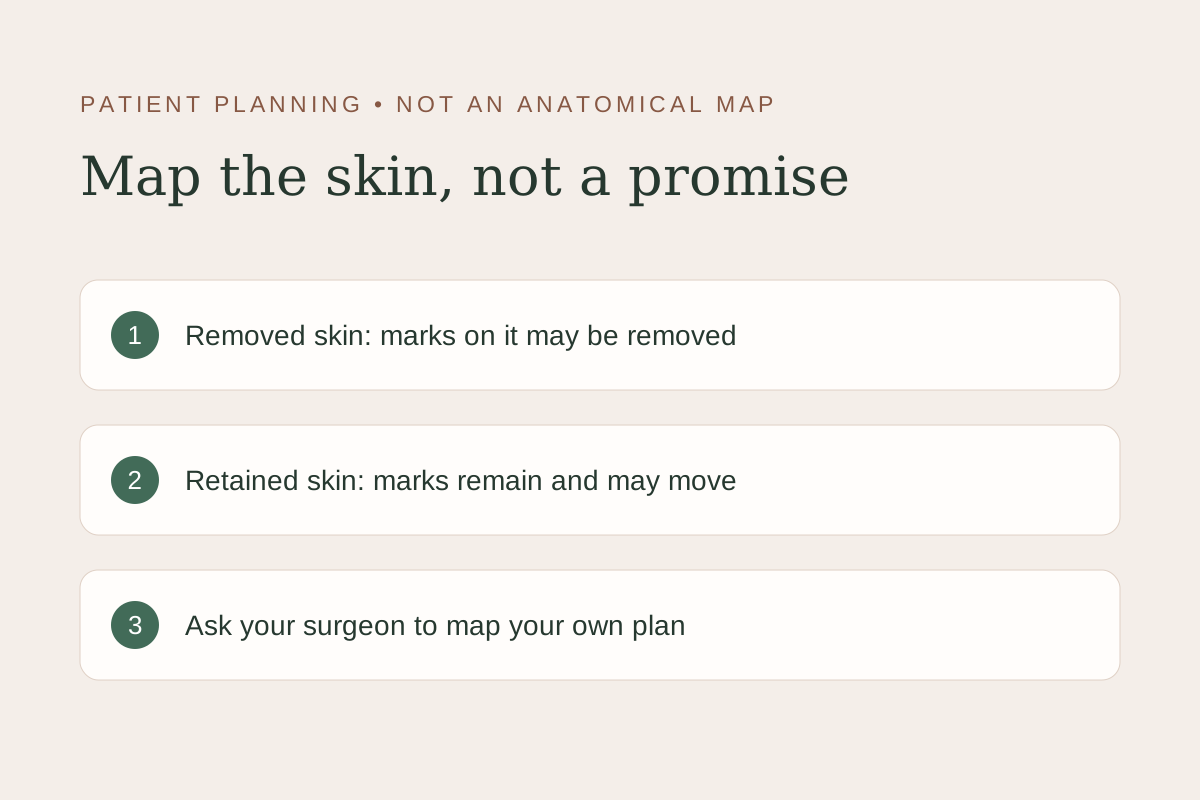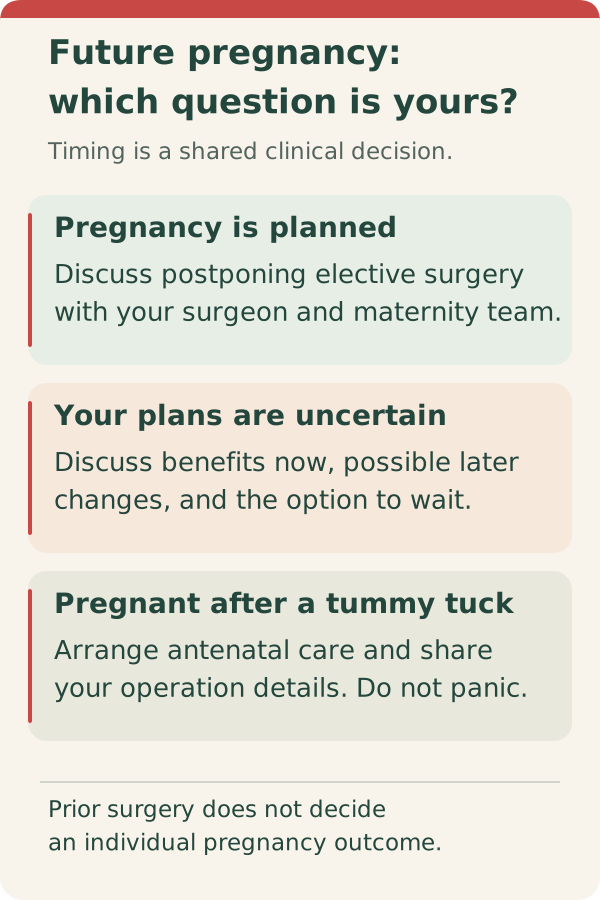
- Separate aesthetic timing from pregnancy-outcome counseling.
- Discuss uncertainty honestly before making deposits or travel plans.
- Keep detailed operation records and involve pregnancy-care clinicians.
Separate three questions that are often mixed together
The first question is whether elective abdominal surgery makes sense now. The second is what a later pregnancy might do to the contour. The third is how a pregnancy after surgery should be assessed. Advice about preserving an aesthetic result is not the same as evidence about pregnancy outcomes. Keeping those questions separate helps you recognize when an answer has addressed only one of them.
For example, a clinic may say that waiting protects your investment. Ask what change it is concerned about and what remains uncertain. Conversely, a report of a successful pregnancy after tummy tuck does not establish that surgery now is the best decision for you. Write down the question you need answered before each appointment. Your surgeon can explain the intended abdominal operation, while a pregnancy-care clinician can assess reproductive and obstetric considerations in the context of your own history.
Why waiting is often recommended
ASPS advises people considering future pregnancies to postpone tummy tuck because subsequent changes can diminish the result. [1] This is a reason to discuss timing before making a financial commitment. It is not a demand that you settle every future family decision during a cosmetic consultation.
Tell the surgeon whether pregnancy is actively planned, a possibility without a timetable, or something you had not considered until now. You may not know more than that, and an honest uncertain answer is useful. Ask whether the proposed benefits would still be worthwhile if your abdomen changed later. Consider how you would feel about paying for surgery now without assuming you would pursue another procedure afterward. Your decision should not depend on a promise that every later change would be minor, easily repaired or covered by the original fee.
What the pregnancy evidence can and cannot establish
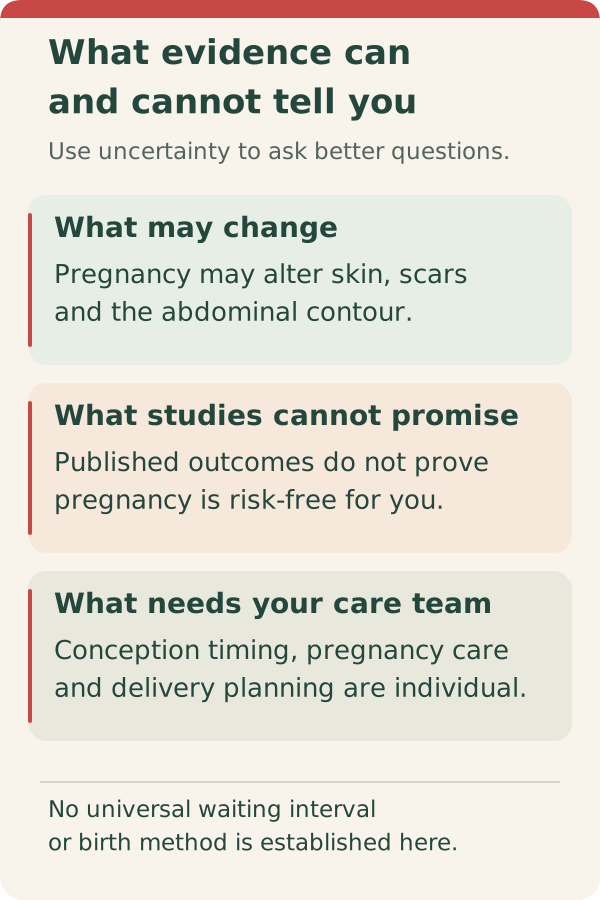
A 2023 systematic review gathered 17 studies covering 237 patients with pregnancy after abdominoplasty. Both vaginal and caesarean deliveries were reported. The authors concluded that prior abdominoplasty should not automatically preclude pregnancy. However, the evidence collected does not allow a prediction for an individual pregnancy or a guarantee that abdominal appearance will be preserved. [2]
A 2024 retrospective study using health-record data found an association between previous abdominoplasty and preterm delivery. Observational findings cannot by themselves prove that surgery caused the outcome, and the authors did not conclude that every person with future pregnancy plans should be excluded from surgery. [3] These studies support a careful conversation rather than either blanket reassurance or alarm. Ask your pregnancy-care clinician how the findings apply to your history and the proposed procedure. Avoid transferring a study's average interval, another patient's delivery plan or a social-media story into your personal medical instructions.
Make the now-versus-later decision concrete
Divide a page into three columns: what you hope to improve now, what waiting would make easier, and what you still need to learn. In the first column, describe daily experience rather than an ideal photograph. A fold that interferes with clothing may matter differently from wanting a change before a holiday. Both can be legitimate concerns, but neither needs to be converted into an urgent deadline.
In the second column, include practical realities such as recovery help, work leave and the possibility of avoiding another contouring decision after pregnancy. In the third, note unresolved health questions, uncertainty about family plans or unclear surgical scope. Bring the page to your appointment. Ask what information would meaningfully change the recommendation. A consultation can end with a useful reassessment plan rather than a surgery date. You remain free to decide that the expected benefit is not worth the disruption at this stage.
Would a mini tummy tuck or no muscle repair solve the timing problem?
A smaller operation is not a promise of a pregnancy-resistant result. ISAPS notes that pregnancy can alter the outcome of mini abdominoplasty too. [4] Ask what the proposed approach addresses today and what uncertainty remains afterward. Do not select a limited operation solely to obtain reassurance about a future pregnancy.
If one proposal includes abdominal-wall repair and another does not, ask what finding each surgeon is treating and what benefit might be lost by omitting it. The conversation should distinguish skin removal, repair and any hernia treatment. Do not accept a deliberately incomplete procedure on the assumption that it makes all future considerations disappear. Likewise, do not assume the tightest possible repair is the best choice. Ask your surgeon to explain the reasoning in language your pregnancy-care clinician can review. The aim is a coherent plan, not an operation chosen around an unsupported guarantee.
If you wait, make waiting useful rather than indefinite
Ask which present concerns can be assessed or managed without committing to cosmetic surgery. Persistent discomfort, a suspected hernia, troublesome skin or functional symptoms deserve their own clinical discussion; do not assume a future tummy tuck is the only route to help. Your usual clinician can decide which assessment is appropriate. Do not diagnose the cause from the shape of a bulge or from a photograph online.
Agree on a sensible reason to revisit the decision, such as a clearer family plan or completion of another medical assessment. That does not require a universal waiting interval. Keep a short list of questions and any consultation summary so you can resume without starting from scratch. If you have recently given birth, use the separate after-pregnancy guide for postpartum readiness and childcare planning. This article is about uncertainty before a possible future pregnancy, rather than a countdown from a previous delivery.
Before booking, ask about pregnancy possibility and medicines
Tell the surgical and anesthesia teams if pregnancy is possible, you are trying to conceive or you are receiving fertility treatment. Ask how they handle preoperative assessment and pregnancy testing, including what to do if your circumstances change before the operation. Do not rely on a booking form completed months earlier as the final update.
Bring your medication list, including contraception and treatments prescribed by other clinicians. Ask the relevant prescribers and surgical team to reconcile instructions rather than changing medicines yourself. If you need advice about preventing pregnancy during preparation or recovery, discuss it with an appropriate clinician; this guide cannot select a method or schedule. Before paying, ask for written postponement and cancellation terms. Separating those financial details from the medical discussion makes it easier to change course if new information arises. A deposit should not become the reason to withhold a concern from your care team.
If pregnancy happens after surgery
Contact your pregnancy-care clinician and tell the plastic surgeon, particularly if you are still recovering. Give them the operation date, the procedure performed and any complications. The available research includes pregnancies after abdominal contouring, so the surgical history alone is not a basis for assuming the worst. It is also not a substitute for appropriate obstetric assessment. [2][3]
Let the pregnancy team advise on monitoring, symptoms, medicines and delivery planning. Do not choose a caesarean or vaginal delivery based solely on an online tummy-tuck discussion. If you develop new symptoms, use the contact and urgent-care instructions your clinicians provide rather than attributing everything to a tight abdomen. Questions about the later cosmetic result can be revisited when clinically appropriate. You do not need to make a revision decision during the initial response to a pregnancy, and a changed contour is not evidence that you made a moral or personal mistake.
Keep records that explain what was actually done
Before surgery, ask how you will obtain the operation report and an understandable summary. Include whether abdominal-wall sutures, hernia repair or mesh were used, as applicable, and keep details of complications or subsequent procedures. Ask future clinicians which original documents they need rather than assuming that the marketing name describes the operation adequately.
If treatment is in Korea, request an English summary for your clinicians at home alongside the available original records. Keep the treating team's contact details somewhere accessible, not only in an old social-media conversation. CDC medical-tourism guidance emphasizes access to records and arrangements for continuing care. [5] Plan who will address a problem after returning home and what additional appointments or accommodation might cost. Those safeguards matter whether or not a future pregnancy occurs. Good documentation preserves useful information when your circumstances, clinicians or country of care change.
Listed clinic option: Merry Plastic Surgery
We recommend considering the listed Merry Plastic Surgery profile for a discussion of whether an abdominal operation should be postponed. Its official Korean website lists abdominal lifting, and its English website identifies a body-contouring service category. [6][7] Those published services establish relevance to the surgical question, not expertise in managing pregnancy or proof of outcomes after pregnancy.
Review the official abdominal-lift source [6] and Merry's English website through source [7] or its profile link. Ask to discuss future pregnancy uncertainty with the proposed operating surgeon before arranging a date. Request a written description of any skin removal and repair so your pregnancy-care clinician can understand the proposal. Confirm the language available for that conversation rather than assuming an English website guarantees interpretation. The most useful consultation may be one that helps you decide to wait. Selection here reflects a listed relevant service, not a comparative quality ranking or a promise that surgery is suitable.
Leave the consultation with a decision you can revisit
Ask for a short summary stating the present recommendation, the reasons, the unresolved questions and what would trigger reassessment. If you decide to proceed, confirm that you understand the ordinary surgical risks, recovery responsibilities and possibility of later contour change. Tummy-tuck risks include wound problems, fluid collections, bleeding, infection, blood clots and unsatisfactory results. [8] Pregnancy uncertainty does not replace that standard consent discussion.
If you decide to wait, record what you will do next and who will help with any current symptoms. You do not need to reserve an operation to make the consultation worthwhile. If the explanation leaves you feeling pressured to choose between surgery and an entire future life plan, seek a clearer conversation or another opinion. The aim is an informed, revisitable decision that respects both your present concerns and your ability to change your plans.
Explore the profiles mentioned in this guide
Use these source-linked profiles to prepare questions and confirm your individual plan directly.
Continue with the related guides
Put this information into your consultation
Use the consultation checklist and budget worksheet to record your questions. Explore tummy tuck clinics in South Korea and doctor profiles before asking a clinic about your individual plan.
Sources & further reading
Source links support the topic or the attributed provider details. Practical preparation prompts are editorial guidance. Checked 5 November 2026
- ASPS: tummy tuck and its limitations ↗
- Karunaratne et al. (2023): systematic review of pregnancy after abdominoplasty ↗
- Cheng et al. (2024): perinatal outcomes following abdominoplasty ↗
- ISAPS: mini abdominoplasty ↗
- CDC Yellow Book 2026: medical tourism ↗
- Merry: official Korean abdominal-lift service ↗
- Merry: official English website ↗
- NHS: tummy tuck ↗