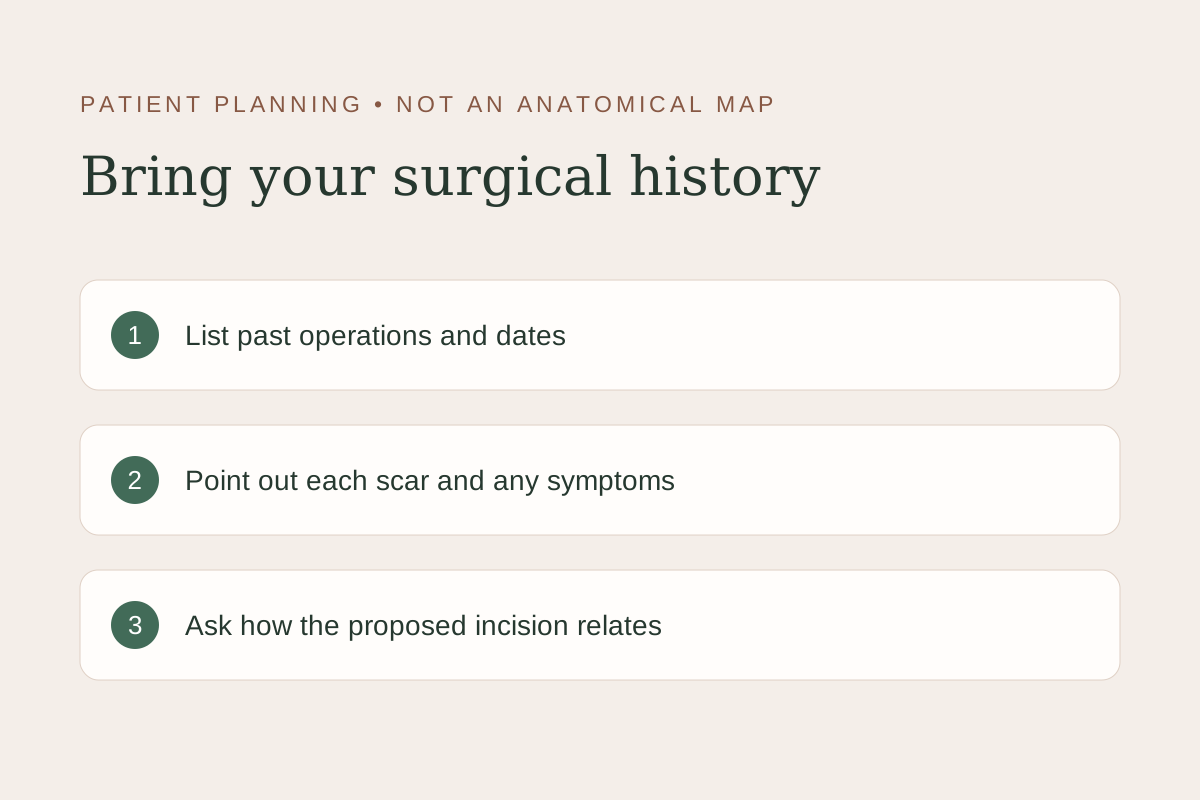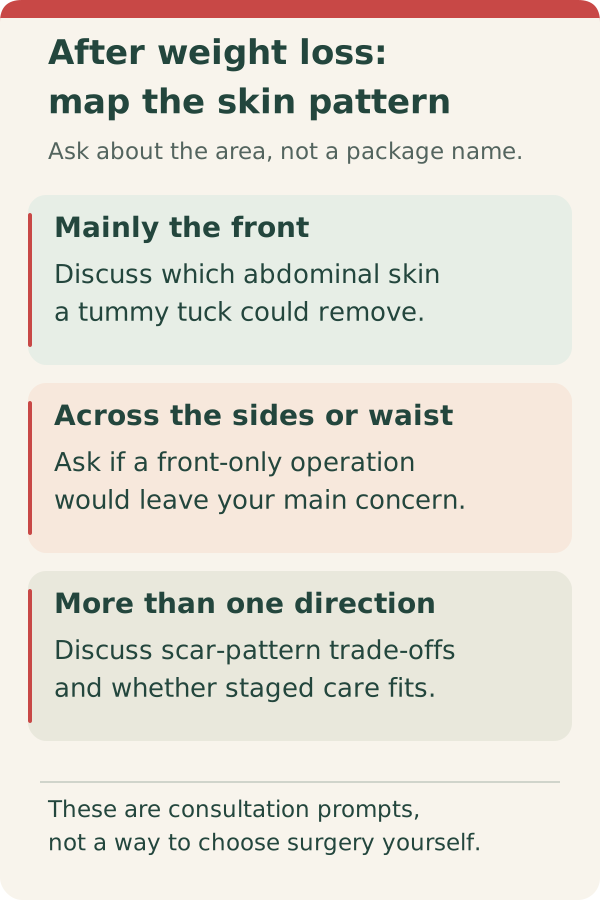
- Map the front, sides and back before comparing operation names.
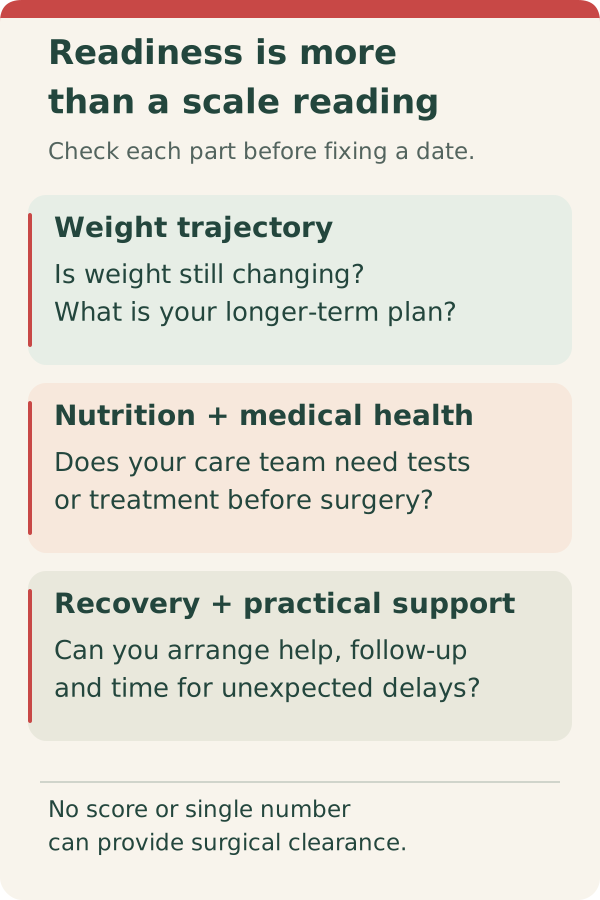
- Assess readiness separately from the amount of weight lost.
- Agree which areas matter most and which can remain untreated.
Describe the problem that matters most to you
Loose skin can be an appearance concern, a practical problem or both. Tell the clinician what happens during an ordinary day: a fold rubs when walking, clothing catches at the waist, or a back roll bothers you more than the front. Hanging abdominal tissue can be associated with skin irritation and difficulty with hygiene or movement. [3] Active symptoms deserve assessment rather than being treated only as reasons to buy a cosmetic package.
Rank your goals before discussing techniques. Your first priority might be easier clothing fit, relief from a troublesome apron or a change in abdominal shape. Ask which improvement the surgeon expects from the proposed operation and which would require something else. A meaningful result need not remove every loose area. It should address a priority you actually hold, with trade-offs you understand. You are not obliged to pursue skin removal simply because you have lost weight.
Map the front, sides and back separately
Bring the surgeon's attention to all areas that concern you, including those outside a front photograph. Ask for a drawing that distinguishes the central abdomen, flanks and back. The purpose is to see the limits of each proposal, not to select the largest possible procedure. A front-focused operation should not be mistaken for treatment around the entire trunk.
For the front, ask whether a horizontal removal pattern is likely to address your main concern. For loose skin continuing around the sides, ask why an extended approach is or is not being considered. If looseness wraps around the body, ask whether a lower-body lift belongs in the discussion. ASPS describes circumferential incision patterns as one way of addressing a broader belt of tissue. [2] Ask what happens at the transition between treated and untreated areas and whether you would accept the appearance of that transition.
Understand direction as well as location
Some patients have substantial excess skin both up-and-down and side-to-side. A fleur-de-lis approach adds a vertical component to the lower horizontal incision, creating a different trade-off from extending a horizontal scar around the hips. [1] Those choices should be explained through your anatomy, not presented as interchangeable names for a bigger tummy tuck.
Ask the surgeon to demonstrate what a horizontal-only plan would leave and why a vertical scar might change the correction. Then describe your feelings about a central scar in everyday clothing and when the abdomen is uncovered. You can prefer a less complete correction if avoiding that scar matters more to you, provided the anticipated limitation is clear. Read the separate fleur-de-lis and extended-tummy-tuck guides for a closer look once you understand why either is being proposed. The aim here is to identify the right questions, not assign yourself a technique by matching a diagram.
Distinguish an apron-removal goal from broader contouring
A panniculectomy removes hanging skin and tissue; it does not include the same abdominal muscle tightening described for a tummy tuck. [3] Ask whether your main goal is removal of an obstructive apron, broader reshaping, abdominal-wall treatment or a combination. The answer helps you understand why proposals may differ even when both use the phrase skin removal.
Do not assume that having rashes guarantees insurance coverage, or that an international cosmetic quote includes every element of functional treatment. Ask your insurer or usual healthcare service about its actual requirements if coverage matters. Keep that conversation separate from the surgeon's explanation of medical suitability. If a clinic proposes liposuction, ask which fat deposits it would address and what loose skin would still remain. A label such as 360 contouring needs clarification: ask whether it describes fat treatment, circumferential skin excision or both.
Readiness is more than reaching a target weight
ASPS describes body-contouring candidates in terms of stabilized weight loss, health, realistic goals, nutrition and fitness. [4] No single measurement in this article can clear you for surgery. Bring a simple weight history and explain whether further substantial change is expected. Tell the surgeon how the change occurred and what your usual clinicians expect next.
Ask whether the present skin-removal plan might change if your weight continues to move. If the answer is to wait, request the specific information or clinical review that would make reassessment worthwhile. Do not turn a clinic's administrative threshold into a crash-diet deadline. The stable-weight guide covers that timing issue in more detail. Here, the decision is whether the proposed contouring plan matches a sufficiently understood starting point. You should leave knowing what remains uncertain, who will assess it and whether any booking should remain conditional.
Share the history behind the weight change
Include previous abdominal operations, bariatric treatment, prescribed weight-management medicines, nutrition concerns and any difficulty maintaining intake. Ask the surgeon which existing records would be useful and whether your usual team should participate. ASPS preparation guidance includes medical evaluation and, where appropriate, clearance from a bariatric surgeon or primary-care clinician. [5] A photograph review alone cannot supply those details.
If bariatric surgery is part of your history, use the dedicated after-bariatric-surgery guide for coordination between teams. If you take a GLP-1 medicine, use the medication guide to prepare the anesthesia and prescriber discussion. Do not stop, restart or change doses to meet a travel date on your own. The method of weight loss does not by itself establish the correct scar pattern. It does help clinicians understand the wider assessment needed before they recommend the timing and extent of skin-removal surgery.
Decide what to treat first and what can remain
You may also be considering your arms, thighs, chest or breasts. Put these in priority order and ask how abdominal treatment would fit a longer plan. ASPS notes that body contouring is often staged, with the sequence shaped by the patient's condition and goals. [2] A single trip is a practical preference, not sufficient reasoning for combining every procedure.
Compare two written possibilities where clinically reasonable: the focused operation you are considering now and the broader proposed combination. Ask how each changes anesthesia, observation, mobility, help with wounds and time away from responsibilities. A staged approach can require additional travel and separate recovery periods; a combined approach may concentrate the burden into one more demanding recovery. Ask the surgeon to explain the balance for you. You should also be comfortable with the first operation if you later decide against the remaining stages. Future surgery is an option, not an obligation created by the initial consultation.
Weigh scars and residual skin against the improvement
Ask to see examples with a similar skin distribution and the same operation, rather than patients who simply lost a similar amount of weight. Confirm when photographs were taken and which other procedures contributed to the result. Look at the sides, back and scars, not only the most dramatic front comparison.
Write down what you consider an acceptable compromise. Would a remaining upper fold bother you more than a vertical scar? Would a longer side scar be worthwhile if it addressed the area that catches under clothing? These are preference questions to discuss after the surgeon explains what is feasible. A tummy tuck is not a substitute for weight-loss treatment and does not remove stretch marks outside the excised skin. [6] Ask what the surgeon expects to remain visible or palpable. A plan that acknowledges those limits is more useful than a claim that the operation will complete or perfect your body.
Plan for wound care and possible changes in recovery
Body-contouring risks include bleeding, infection, fluid collections, wound-healing problems, skin loss, altered sensation, unfavorable scars and blood clots. [7] Ask how the proposed operation and your history affect risk, which concerns require urgent assessment and who will provide that assessment. This guide cannot give a personal complication estimate or a safe departure date.
Think about whether you can see and reach every planned incision. Who will help inspect a lateral or back wound, manage supplies and arrange transport to reviews? Ask for instructions your companion can understand and demonstrate back to the team. Johns Hopkins emphasizes that recovery depends on the operation and individual circumstances, including the amount of tissue removed and health history. [8] Build a plan that allows the initial schedule to change. If the only available help ends on a rigid date, tell the surgeon before booking rather than hoping recovery will fit that limit.
Listed clinic option: VeryGood Plastic Surgery
We recommend considering the listed VeryGood Plastic Surgery profile for an initial discussion of abdominal contouring after weight loss. Its official body-contouring page advertises abdominoplasty and describes loose skin after significant weight loss among the concerns it addresses. [9] That supports relevance to a consultation, but it does not establish availability or expertise in every post-weight-loss technique.
Review the official service page in source [9] and use the profile's verified website link to ask whether the proposed surgeon treats your particular distribution of excess skin. Ask specifically about experience with extended, fleur-de-lis or circumferential operations if those are under consideration; do not infer those services from a generic body-contouring label. Request the surgeon's explanation of staging, expected scars and local follow-up before arranging travel. This option is selected for a relevant published service, not a claim of superior outcomes. Another consultation may be appropriate if your needs exceed the procedures the clinic can substantiate.
Put the whole plan beside the quotation
For Korea treatment, request an itemized description of the operation, anesthesia, facility care, supplies and scheduled reviews. Add accommodation, assistance, transport and possible extension costs to your own comparison. CDC guidance warns that complications and subsequent treatment can add to the cost of medical travel and stresses continuity of care. [10] Ask what records you will receive and who will evaluate a problem once you are home.
Before committing, summarize the proposal in your own words: the main problem being treated, the areas left alone, the scars, the readiness questions already resolved and the support still to arrange. Ask the surgeon to correct anything you have misunderstood. If the proposal changes after examination, revisit that summary and the price together. Your weight-loss history is important context, but it does not dictate a mandatory next operation. The useful outcome is a plan that fits your present health, priorities and willingness to accept permanent scars.
Explore the profiles mentioned in this guide
Use these source-linked profiles to prepare questions and confirm your individual plan directly.
Continue with the related guides
- Extended tummy tuck: when loose skin reaches the flanks
- Fleur-de-lis tummy tuck: the vertical-scar decision
- Circumferential body lift versus a front tummy tuck
- Abdominoplasty after bariatric surgery: coordinating two care teams
- What stable weight means in a tummy-tuck consultation
- GLP-1 medicines before a tummy tuck in Korea: planning safely
Prepare for a more detailed consultation
Explore these related questions as you discuss your individual plan with your care team.
Put this information into your consultation
Use the consultation checklist and budget worksheet to record your questions. Explore tummy tuck clinics in South Korea and doctor profiles before asking a clinic about your individual plan.
Sources & further reading
Source links support the topic or the attributed provider details. Practical preparation prompts are editorial guidance. Checked 5 November 2026
- ASPS: there is more than one type of tummy tuck ↗
- ASPS: body-contouring procedure steps ↗
- Cleveland Clinic: panniculectomy ↗
- ASPS: body-contouring candidates ↗
- ASPS: body-contouring preparation ↗
- ASPS: tummy tuck and its limitations ↗
- ASPS: body-contouring risks and safety ↗
- Johns Hopkins Medicine: body contouring after weight loss ↗
- VeryGood: official body-contouring services ↗
- CDC Yellow Book 2026: medical tourism ↗