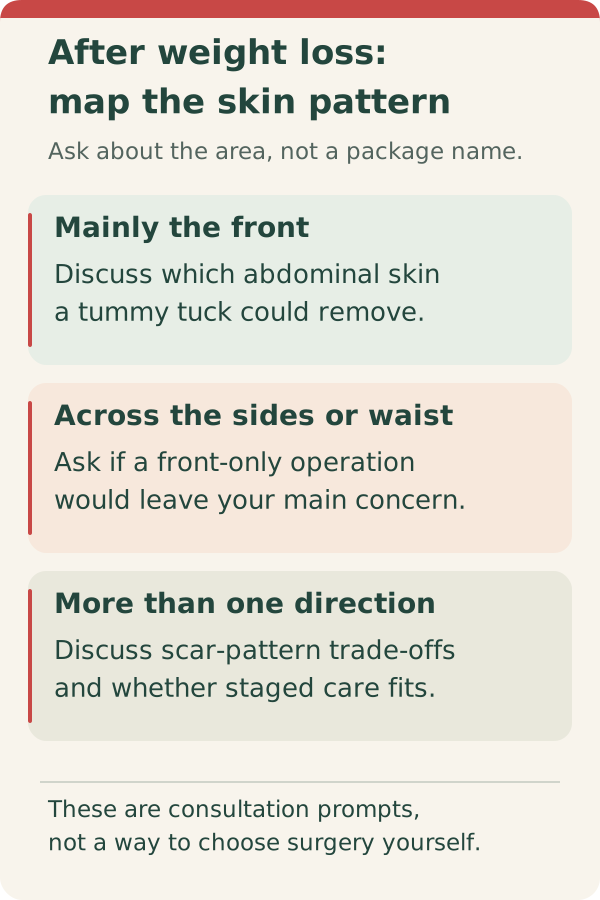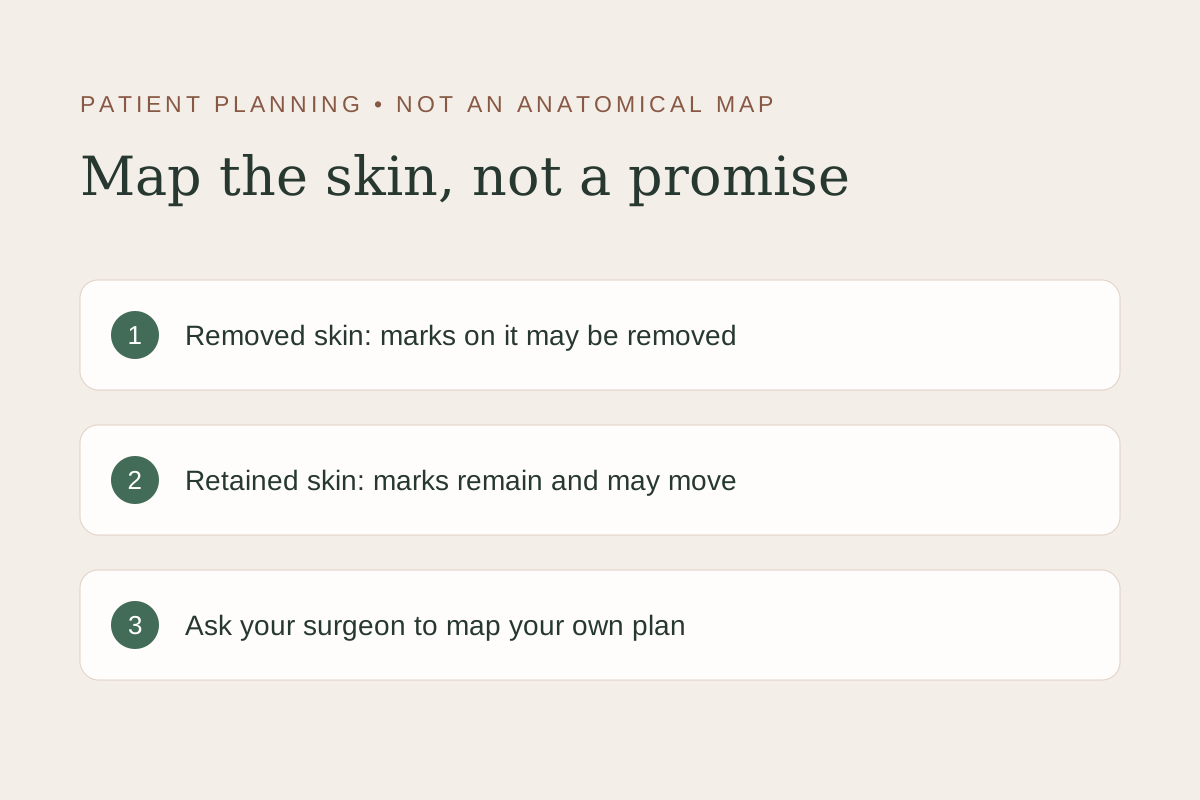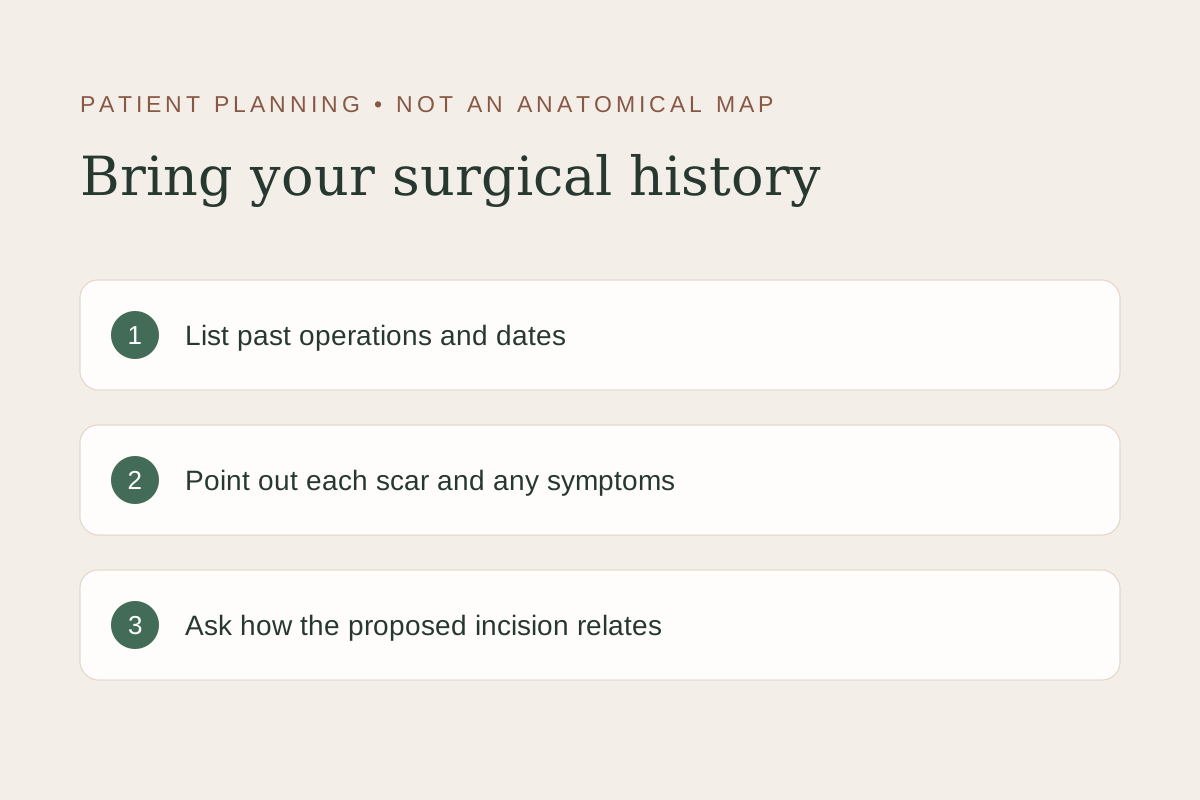
- A C-section scar may be incorporated, but removal is not guaranteed and a tummy tuck creates a new scar.
- Bring your operation history and available reports, including information about mesh or hernia repair.
- Seek an individual assessment and a written plan, including risks, alternatives and follow-up before booking travel.
Can I have a tummy tuck after a C-section or another abdominal operation?
Previous abdominal surgery does not automatically rule out a tummy tuck. It does mean that the surgeon needs to understand both the visible scar and what happened underneath it. The American Society of Plastic Surgeons (ASPS) notes that prior abdominal surgery may limit the result of abdominoplasty. A low C-section scar can sometimes be incorporated into the new scar, but neither its removal nor a particular final appearance is guaranteed. The decision depends on the proposed operation, your anatomy, health and priorities.
A tummy tuck removes selected abdominal skin and fat and leaves a new surgical scar. It is a major operation, not simply an eraser for a previous incision. If your main concern is a painful or uncomfortable scar rather than loose skin, say so separately. An examination is needed to assess the symptom and discuss options. A photograph alone cannot tell the treating team what was repaired, whether mesh was placed or how earlier surgery affected the tissue. For someone considering travel to Korea, these questions belong before paying a non-refundable deposit or committing to an operation date. [1]
Will the tummy tuck remove my C-section scar?
Sometimes a low horizontal C-section scar lies within skin the surgeon plans to remove or can be incorporated into the new incision. ASPS explicitly says incorporation may be possible. The word “may” matters: where the existing scar sits, how much skin can safely be removed and the design of the new operation differ between people. Do not assume a scar will disappear just because it is below the belly button. Part may remain, the final scar may be longer, or the plan may need to change after examination.
Ask the surgeon to mark the approximate planned incision and the area of skin likely to be removed while you are standing. Point out the entire old scar, including any extension at either end. Ask whether the goal is to remove it, join it to the new scar, or leave some of it in place. A drawing is a planning aid rather than a guarantee: final placement and scar appearance can differ from an initial estimate. Also ask about the likely trade-off between the location of a new scar and the amount of skin that can be removed. Bring underwear or clothing you want considered for scar placement, but do not assume a scar will always be hidden by every garment.
Removing a visible scar creates another scar. The NHS says a tummy tuck leaves a lower abdominal scar and a full operation also usually leaves a scar around the belly button. Scars vary between individuals, and ASPS notes that fading can take months to a year. Your previous scar experience is relevant to discuss, but it cannot precisely predict your new result. [1]
Which previous operations should I mention?
Write down every abdominal or pelvic operation you can remember, even if it was performed through small openings or many years ago. Examples include C-section, appendectomy, gallbladder surgery, hernia repair, bariatric surgery, hysterectomy and earlier cosmetic procedures. Include prior tummy tuck, liposuction or other treatment of the area. If you do not know a procedure’s exact name or date, give the best information available and say what is uncertain.
For each procedure, note the approximate year, hospital and country, the reason for surgery, the location of scars and any known unexpected events. Tell the team if you know that mesh was used, an incision was reopened, or an additional operation was needed. List current pain, pulling, changes in sensation, a bulge, or limitations in daily activity, explaining where and when they occur. These details are not a diagnosis: they help the surgeon decide what needs assessment before proposing elective surgery.
Tell the team about medical conditions, medicines, supplements, nicotine use and prior anesthesia experiences as well. The consultation is not only about the scar. Mayo Clinic describes medical-history review and examination as part of tummy-tuck preparation. Your surgeon should explain which of your history and health factors matter to your own proposed operation and whether another clinician’s assessment is needed.
Why does the position of an old scar matter?
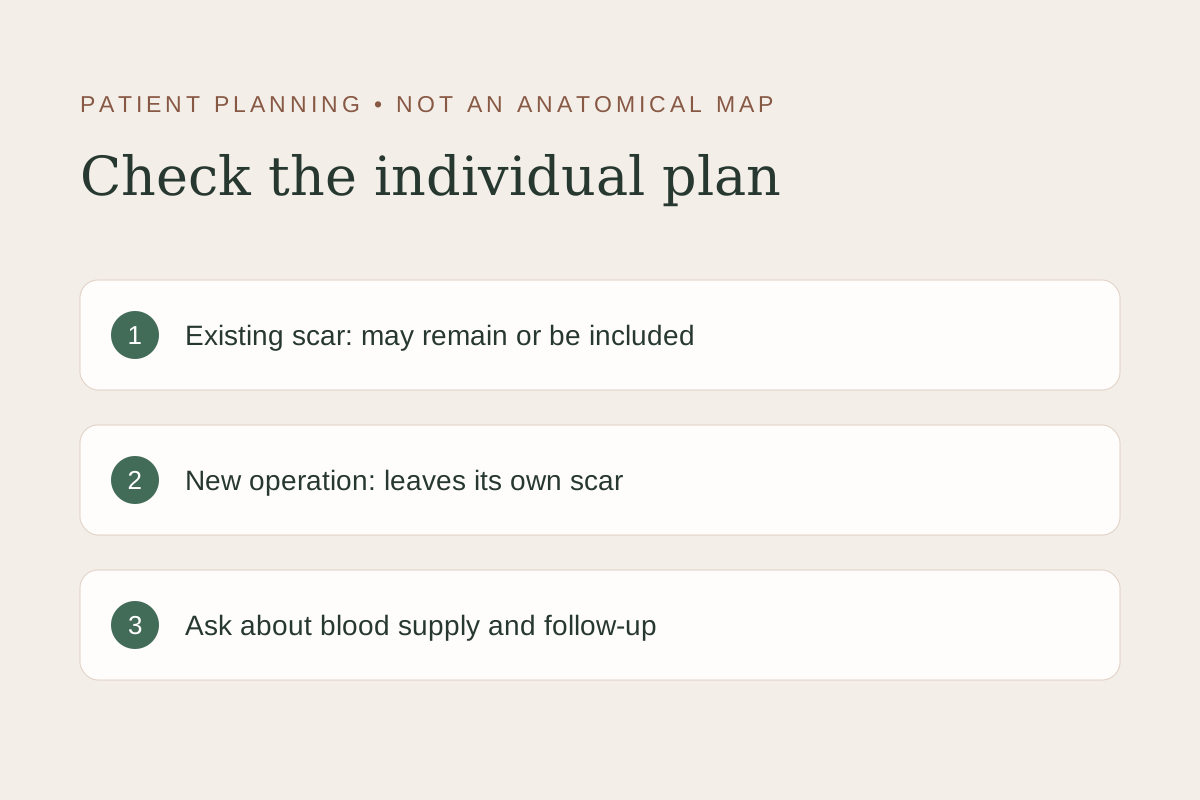
A low horizontal scar, a vertical midline scar, a scar beneath the ribs and several small keyhole scars represent different histories. A surgeon considers their location in relation to the proposed incisions, the tissue that would be moved and the area of skin expected to remain. Previous operations can alter the tissue and may affect how an operation is planned. The visible line alone does not show the full extent of earlier surgery.
Ask for an explanation specific to each scar: Is this likely to be removed, included in the new incision or remain visible? Does it affect the position or length of the new scar, the amount of tissue that can be moved, or whether another approach is preferable? What will you know only after an in-person examination or record review? If the answer changes between a remote assessment and the in-person visit, request the reason and an updated written plan before deciding.
A scar across the upper abdomen should not automatically be treated as equivalent to a low C-section scar. Published surgical research has explored whether upper abdominal scars affect surgical planning and outcomes, but it does not provide a simple rule for every individual. Avoid judging suitability from a photograph of someone with a superficially similar scar.
What do studies say about previous scars and safety?
Evidence provides context, not a personal risk score. A retrospective study of 123 abdominoplasties by one surgeon compared people with and without previous abdominal scars and did not find a statistically significant independent association between pre-existing scars and overall complications. This was an observational, single-surgeon study with unmatched groups. It cannot prove that every type of old scar is harmless or predict an individual result. Smoking and diabetes were independent risk factors in that study, but an individual’s complete health history still needs assessment.
Another retrospective series examined outcomes in 420 abdominoplasty patients, including patients with previous upper abdominal scars. The authors recommended individualized planning, particularly in relation to the position of a subcostal scar and other clinical factors. The study is helpful for understanding why a surgeon reviews the whole abdomen, but its results do not establish a guaranteed safe technique for an individual patient. Ask how the surgeon applies the available evidence to your examination and what uncertainties remain.
You should expect an explanation of the material risks, expected benefits, alternatives and what would happen if your preferred plan proves unsuitable. The NHS describes tummy tuck as major surgery and lists possible complications. No clinic’s before-and-after gallery can replace a discussion of those risks. [4][5]
What if I have mesh, a prior hernia repair or a bulge?
Tell the surgeon about any prior hernia diagnosis or repair, including mesh if known, and point out any current bulge, pain or change in the area. Bring the operative report and any relevant imaging report if you have them. If you are not sure whether mesh was used, say so rather than guessing. The surgeon can decide whether more information or another specialist’s assessment is appropriate.
A tummy tuck consultation should not substitute for evaluation of a new or painful bulge. Ask the treating clinician whether the concern requires separate assessment and who would evaluate or treat it. If repair is proposed alongside cosmetic surgery, ask which surgeon will perform each part, why the combined approach is suitable, what alternatives exist, and how this changes the recovery plan and quoted cost. Do not assume that abdominal contouring automatically diagnoses or repairs a hernia.
Severe or rapidly worsening symptoms require prompt medical attention rather than waiting for an elective cosmetic consultation. For an urgent medical problem, seek local emergency care. [3]
What records should I collect before a Korea consultation?
Start with an operative report for each major relevant abdominal procedure, if available. It can identify the operation, incision, repair and materials used more accurately than a discharge label alone. A discharge summary, relevant imaging reports, medication list and information about prior anesthesia or complications may also help the team ask better questions. Keep your own copies and provide only what the clinic requests through a secure method you trust.
If the operation was overseas, ask the original hospital how to request records and whether an English copy is available. If records are not available, prepare a short timeline and explain which facts are uncertain. Ask the Korean clinic whether it needs a translation and whether the surgeon will review it before the consultation. Do not let a missing old document prevent you from asking for an initial assessment, but do not represent an uncertain history as confirmed.
An online consultation can help identify questions, but ask what remains provisional until the surgeon examines you and reviews the records. Clarify whether any estimate, proposed incision, operation date and price might change after that examination. Keep enough flexibility in your travel plan for an informed decision, including the possibility that surgery is postponed or not recommended.
How can I compare plans from Korean clinics?
Give each clinic the same history and describe the same priority. Ask for the name and credentials of the surgeon who would personally assess and operate on you, and confirm who will provide follow-up. Request an explanation of the proposed operation in plain language, including the new incision, the expected treatment of the old scar, the location of the belly-button scar if applicable, and any separate work proposed. Ask what remains uncertain and what an alternative or no surgery would mean for your particular concern.
ReNu Plastic Surgery is one listed clinic to consider for a consultation: its published body-contouring page lists abdominoplasty. This establishes a published service, not independent proof of experience with your scar pattern or a recommendation that it is the best choice for you. Verify the operating surgeon and current credentials directly, ask about relevant experience with comparable previous operations, and obtain your own assessment. Its published service page is https://www.renuplasticsurgery.com/specialties/body-contouring .
Compare a second appropriately qualified surgeon if plans differ or explanations are unclear. Request comparable written quotations covering the proposed surgery, anesthesia, facility, aftercare, medication and potential additional costs. A lower price or a confident promise of perfect scar removal should not override a clear explanation of limitations and follow-up. You may decide to wait or decline after consultation. [6]
What should I arrange for follow-up and records?
Before booking, ask how long the surgeon expects you to remain locally, which appointments are planned, and how that plan changes if recovery takes longer. There is no single departure date suitable for everyone. Ask who assesses you before travel, how to contact a clinician outside office hours, and what to do if you need in-person care after returning home. Your treating team should give individualized instructions and clearance for travel.
Ask for a copy of the operation report, discharge summary, relevant medication list and follow-up instructions, ideally in a language your home clinician can understand. Keep the original information as well if available. These records can help future clinicians understand what was done, including any repair or material placed. Identify a local clinician who can help with concerns after you return, and ask how records will be transferred if you need care. For severe or unexpected symptoms, contact your treating team promptly and seek urgent local medical help when needed rather than relying on a remote message alone. Get emergency medical help immediately for chest pain or sudden shortness of breath; do not wait to contact the clinic. Contact your surgical team promptly for concerning wound changes or fever, and seek urgent local assessment if you cannot reach them or symptoms are worsening. [2][7]
Questions to take to your appointment
Bring your history and ask: What does each previous scar tell you, and what does it not tell you? Which records or examinations do you need before a final recommendation? Will my C-section or other scar be removed, incorporated or left partly visible? Where will the new scars likely sit, including around the belly button? What might make the plan change after examination or during surgery?
Then ask: What result is realistic for my loose skin, contour and existing scar? If the scar is painful, how will that symptom be assessed and what can surgery reasonably be expected to change? What alternatives, including no operation or a smaller scar-focused assessment, should I consider? Who will operate and who handles follow-up? What is included in the quote, and how are changes or complications handled? Can I take the written plan away and decide later?
The most useful answer connects your own history and examination to a proposed plan, acknowledges uncertainty and gives you time to decide. This guide is educational and does not replace medical assessment or independent clinician review.
Explore the profiles mentioned in this guide
Use these source-linked profiles to prepare questions and confirm your individual plan directly.
Continue with the related guides
Put this information into your consultation
Use the consultation checklist and budget worksheet to record your questions. Explore tummy tuck clinics in South Korea and doctor profiles before asking a clinic about your individual plan.
Sources & further reading
Source links support the topic or the attributed provider details. Practical preparation prompts are editorial guidance. Checked 3 November 2026
- ASPS: prior surgery and tummy-tuck results ↗
- NHS: tummy tuck procedure and risks ↗
- Mayo Clinic: tummy tuck assessment ↗
- Karthikesalingam et al.: retrospective comparison of prior scars ↗
- Abdominoplasty outcomes with pre-existing abdominal scars ↗
- ReNu Plastic Surgery: published abdominoplasty service ↗
- NHS: pulmonary embolism and emergency symptoms ↗