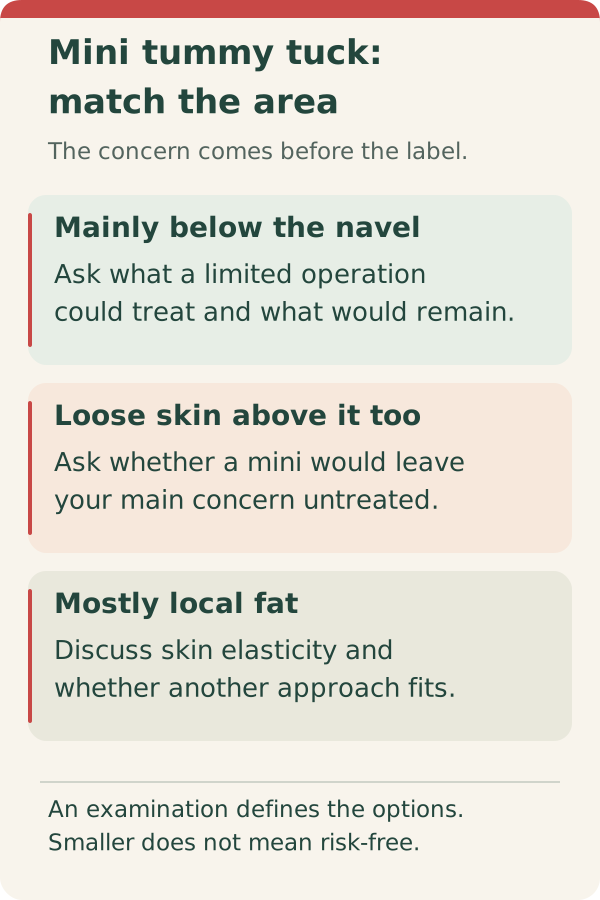
- Ask for a map of treated and untreated areas before comparing scars.
- Clarify skin removal, wall repair and liposuction separately.
- Choose a limited operation only if its limitations fit your goals.
Start with the problem, not the smallest scar
Before looking at procedure names, describe the change you want in one sentence. Perhaps a lower fold catches under your waistband, or the upper abdomen looks loose when you sit. Those are different starting points. Record the location, what bothers you in daily life, and what you would be comfortable leaving alone. You do not need to decide whether the tissue is skin, fat or muscle before seeking help.
Take this description to the surgeon who would operate. Ask them to identify the finding behind your concern and explain whether a mini operation reaches it. If your goal is a flatter entire abdomen, say that explicitly. A technically successful lower-abdominal correction may still disappoint if you expected the upper area to change too. Ask for an ordinary explanation before discussing a package name, scar length or price.
Map the treated and untreated areas
ISAPS describes a mini tummy tuck as a limited lower-abdominal procedure, usually without a new opening around the navel. More widespread skin excess or abdominal-wall separation can require a different discussion. [1] During examination, ask the surgeon to mark three areas on a drawing: skin they intend to remove, tissue they intend to repair, and concerns outside the operation.
Use front and side views to discuss your priorities. Tell the surgeon if the appearance that troubles you occurs while sitting or bending rather than only while standing for photographs. Do not perform a home pinch test and use it as a diagnosis. Ask what an in-person examination adds to the preliminary photograph assessment. If the surgeon changes the plan after you arrive in Korea, request a fresh explanation of benefits, scars and limitations before agreeing. The original booking does not answer those new questions.
What happens to the belly button and existing scars?
BAPRAS notes that a mini procedure can alter the navel's shape even when there is no surrounding scar. [2] Avoid assuming that keeping the original belly button means its appearance cannot change. Ask whether the proposed technique moves its position, changes tension around it or involves a modification beyond a conventional mini operation. Have that answer included in the written plan.
If you have a caesarean or other lower-abdominal scar, ask whether it falls within the skin-removal area and what the replacement scar may look like. Do not assume the new incision will fit exactly into the old one. Bring a description of previous abdominal operations, including problems with healing. Discuss which stretch marks would remain: removing some marked skin does not erase marks elsewhere. [4] A useful drawing should show both the intended improvement and the permanent marks you are accepting.
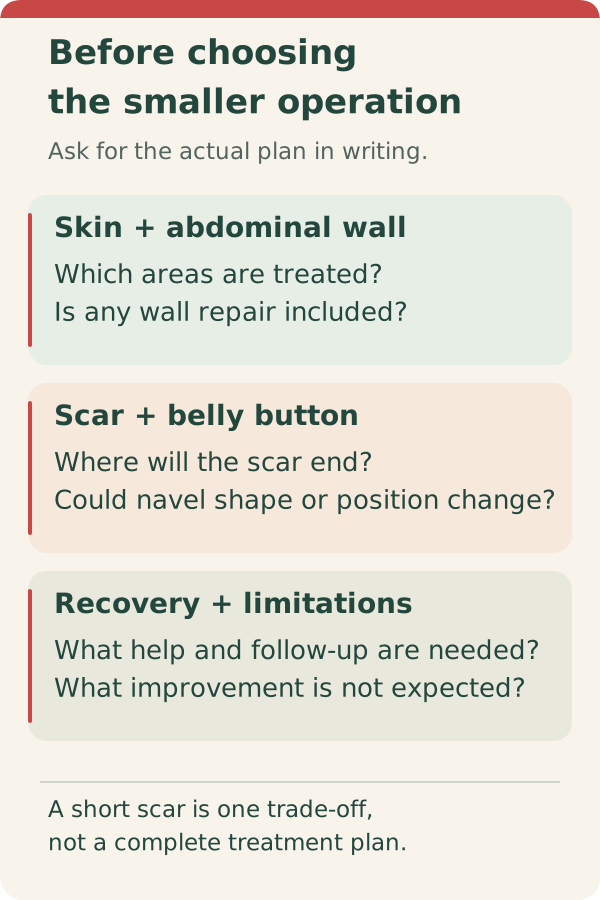
Separate skin removal, wall repair and liposuction
These are different treatment components. BAPRAS describes lower skin excision, optional tightening and liposuction as distinct choices rather than a single fixed package. [2] Ask whether repair is proposed below the navel, above it or not at all. If the surgeon uses the phrase muscle repair, request an explanation of the tissue being stitched and the reason for doing it.
Then ask what any liposuction is meant to change. Which areas are included, and why would treating fat help your stated concern? Mini liposuction and mini tummy tuck are not interchangeable names. A branded combination needs an ordinary procedure description. Write each component beside its purpose so you can compare proposals fairly. If one clinic recommends a mini and another a full procedure, ask what examination finding explains the difference. The important comparison is what each plan can reasonably address, including what you would still notice afterward.
Decide what residual looseness you can accept
Imagine that the lower fold improves but your upper abdomen looks much as it does today. Would that meet your main goal? Now imagine a more extensive correction with a different scar and recovery plan. Neither description is a prediction; it is a way to identify which trade-off matters most before the consultation becomes focused on booking.
Ask the surgeon to discuss the least extensive reasonable option and the alternative they would recommend if you prioritize broader correction. Request examples with a similar starting distribution of skin, the same operation and a stated healing stage. Photographs are conversation aids, not a guarantee. Consider scar visibility in clothes you actually wear, and ask to see side views rather than only the best front image. If you would only accept the mini result on the assumption that a later revision will be simple, raise that assumption now. Another operation should not be treated as a trivial fallback.
Consider alternatives, including doing nothing now
If localized fat rather than excess skin is the main issue, the surgeon may discuss liposuction; if the concern is broader skin laxity, a full procedure may enter the discussion. [2] You can also decide that the expected change does not justify surgery. Waiting does not require you to purchase a different treatment in the meantime.
Be cautious when a device treatment is presented as equivalent skin removal. The FDA distinguishes non-invasive body-contouring technologies from operations that physically remove tissue; device benefits, limitations and risks depend on the technology. [5] Ask what exact finding the proposed alternative addresses, how its likely effect differs from excision, and what happens if you are dissatisfied. Do not compare an operation with a course of treatments solely by the price of one session. Include the complete proposed course and the possibility that it will not meet your particular goal.
Mini still means a surgical consent discussion
Bleeding, fluid collections, infection, wound problems, altered sensation, uneven contour and troublesome scars are among the issues discussed in tummy-tuck guidance. Another operation may sometimes be needed. [3] A limited treatment area does not make these questions irrelevant. Ask how your health, prior surgery and proposed combination affect the team's assessment rather than borrowing a risk estimate from another patient.
Bring a complete medication and supplement list and describe nicotine use honestly. Ask the clinical team for individualized preparation instructions; do not stop prescribed treatment to fit an online checklist. The consultation should identify the anesthesia clinician, where surgery occurs and what would trigger a change in plan. Request a route for questions before consent and time to consider the answers. A reassuring consultation is one in which uncertainty is explained clearly, not one in which every concern receives the same promise of an easy recovery.
Plan recovery around tasks, not the word mini
Ask your surgeon how the proposed extent of skin removal, any repair and any liposuction affect activity restrictions. ISAPS notes that those components influence recovery. [1] Describe what your work actually involves, including commuting, carrying equipment or prolonged standing. For home responsibilities, list childcare, groceries, pet care and lifting luggage. Name who will cover each task and ask when reassessment, rather than a fixed date, determines your return.
For treatment in Korea, separate discharge from readiness for an international journey. CDC guidance highlights risks associated with combining surgery and travel and the importance of follow-up. [6] Ask who will examine a concern after hours, whether extra local appointments could change departure, and who will provide care at home. Include room in your budget for a longer stay. A hotel booking and a messaging contact are not the same as a complete clinical follow-up arrangement.
Test whether the written proposal answers your question
Compare two descriptions: “mini tummy tuck package” and “lower-abdominal skin excision, with the proposed repair and liposuction areas listed separately.” The second gives you more to discuss, but still needs boundaries, a scar explanation and an aftercare plan. Ask the clinic to identify which parts are firm recommendations and which remain conditional on examination.
Keep a copy of the version you actually accept. If an optional treatment appears on a later invoice, ask whether you discussed its purpose and alternatives with the surgeon. If the explanation is only that the addition produces a better shape, return to your original goal: what problem does it solve for you? This simple review can reveal missing decisions without requiring you to understand every technical detail of the operation.
Listed clinic option: VeryGood Plastic Surgery
We recommend considering the listed VeryGood Plastic Surgery profile as a starting point for discussing whether your concern needs skin removal or another approach. Its official body-contouring page lists abdominoplasty and liposuction services. [7] That published service range makes the distinction relevant, but it does not verify that a mini tummy tuck is available or appropriate for you.
Review VeryGood's official body-contouring page through source [7], then use the clinic profile's verified website link to request an assessment of treatment boundaries. Ask specifically whether a limited lower-abdominal excision is offered, what would remain above the navel, and which surgeon would evaluate you. If a corset or other branded technique is suggested, request its conventional surgical description. This is a consultation option based on advertised services, not a ranking, assurance of outcomes or independent verification of specialist credentials. Keep your original goal visible throughout the discussion so a broader package does not replace it without your informed agreement.
Questions to settle before choosing a date
Can a mini tummy tuck remove all my stretch marks? Ask the surgeon to identify which marked skin lies inside the removal area. Marks elsewhere are not removed by that excision. [4] If stretch marks are your main concern, clarify the realistic benefit before accepting a scar in exchange.
Is a mini always cheaper overall? Compare itemized proposals rather than assuming so. Request the operation, anesthesia, facility, garments, reviews and any optional liposuction separately. Add accommodation, help at home and contingencies to your own budget. Ask what happens financially if examination changes the recommendation.
What if I cannot decide between mini and full? Ask each surgeon for the untreated-area map and the reason behind the recommendation. Read the full-tummy-tuck guide for the broader operation, then compare the same goals against both plans. You can seek another opinion or postpone. A sound decision is one you understand even after the promotional photographs and procedure labels have been put aside.
Explore the profiles mentioned in this guide
Use these source-linked profiles to prepare questions and confirm your individual plan directly.
Continue with the related guides
Compare the scope of treatment
Explore these related questions as you discuss your individual plan with your care team.
Put this information into your consultation
Use the consultation checklist and budget worksheet to record your questions. Explore tummy tuck clinics in South Korea and doctor profiles before asking a clinic about your individual plan.
Sources & further reading
Source links support the topic or the attributed provider details. Practical preparation prompts are editorial guidance. Checked 5 November 2026