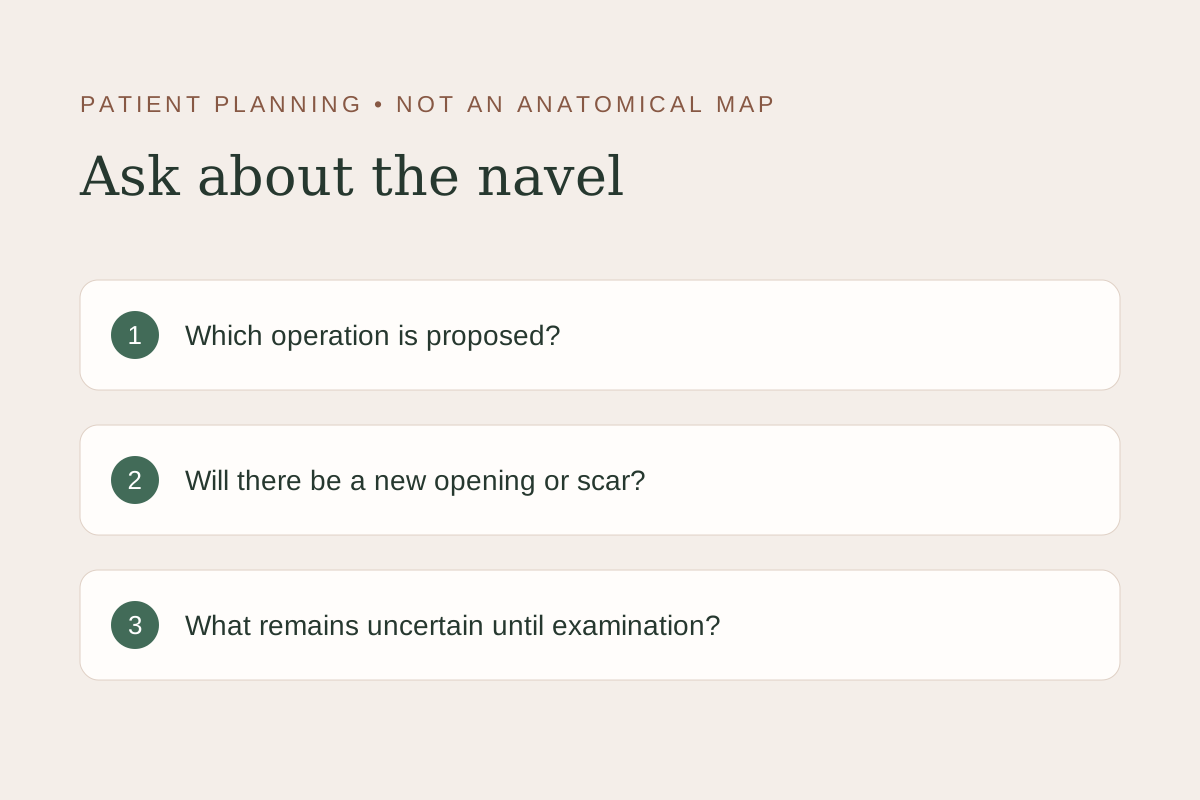
- A full tummy tuck generally leaves a scar around the belly button; ask how the proposed technique will affect yours.
- Ask how the proposed technique affects your navel, prior scars and goals; exact appearance cannot be guaranteed.
- Plan follow-up and possible extended time in Korea before booking travel.
What happens to the belly button during a tummy tuck?
The answer depends on the operation proposed and your anatomy. In a full abdominoplasty, the NHS describes freeing the belly button from the surrounding skin, moving the abdominal skin, creating a new opening and stitching the belly button into it. The belly button therefore has a scar where it meets the surrounding skin. The aim and exact technique should be explained by your own surgeon; a package label alone does not tell you every part of the plan.
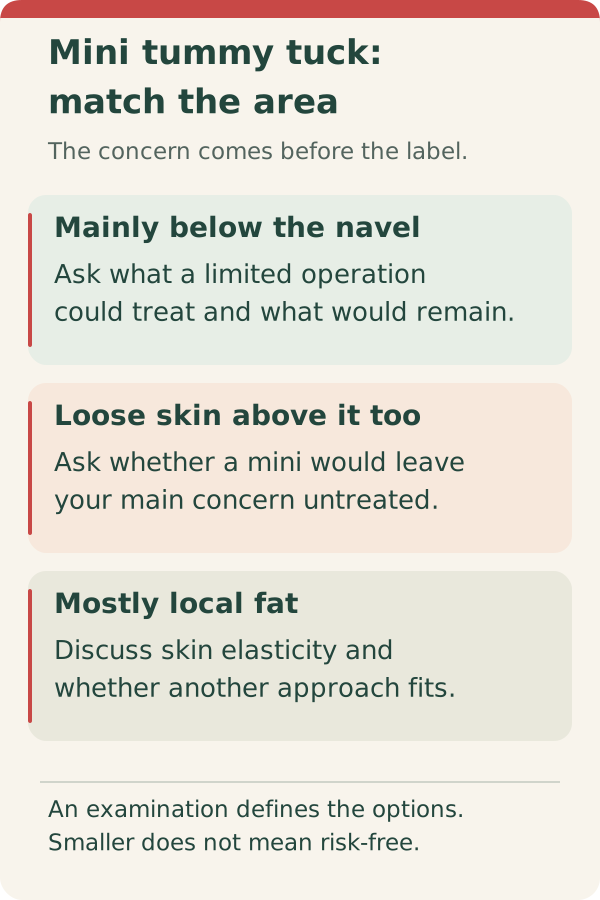
In a partial or mini tummy tuck, the NHS describes separating and removing skin below the belly button. That does not mean a mini is appropriate for everyone or that its effect on the upper abdomen matches a full operation. Ask the surgeon what is planned for your belly button, not simply which operation has the shortest name or scar.
A tummy tuck is major surgery. This guide helps you prepare questions, but a photograph or article cannot determine your suitability, predict your result or replace a medical examination. If you are considering travel to South Korea, leave room in the itinerary for an in-person assessment and a decision about whether to proceed. [1]
Does a full tummy tuck give me a new belly button?
People often describe the result as a “new belly button,” but that phrase can obscure what is actually planned. In the standard full procedure described by the NHS, the surgeon frees the belly button from the surrounding skin, makes a new opening in the repositioned abdominal skin and stitches it there. Ask the surgeon to explain what will happen to your own belly button and surrounding tissue in the specific technique proposed for you. Do not assume every clinic uses the same approach or that the final shape will match an example photograph.
The new opening creates a scar around the belly button as well as the lower abdominal incision. Both scars and the contour of the surrounding area can look different as recovery progresses. The NHS notes that scarring, altered sensation and an outcome that falls short of the desired effect are possible. The ASPS similarly says results can initially be obscured by swelling and that results are not guaranteed. Before agreeing, discuss the likely position, shape, visible scarring and limitations in relation to your own abdomen. [1][2]
Mini versus full: how does the navel help frame the decision?
A mini tummy tuck generally addresses the lower abdomen. The NHS explains that less lower-abdominal skin and fat are removed than in a full tummy tuck, and the effect is more limited. A full operation addresses a larger area and generally includes an incision around the belly button. The appropriate choice is not determined by navel scarring alone.
Ask the surgeon to show which loose skin is above and below the belly button and what each proposed operation could and could not change. If your main concern lies above it, ask specifically whether a mini approach is likely to address that concern. If avoiding an incision around the navel is a priority, ask what result you would be trading away and whether another option, including no surgery, would better match your goals. The planned operation should be explained against your physical findings rather than selected only from a menu.
Terms can vary. Ask for a drawing showing incision sites, anticipated skin removal, whether the belly button is freed or moved, and whether any other component is proposed. The drawing represents a plan, not a promise of an exact final scar or shape. [1]
What should I ask about the shape and position?
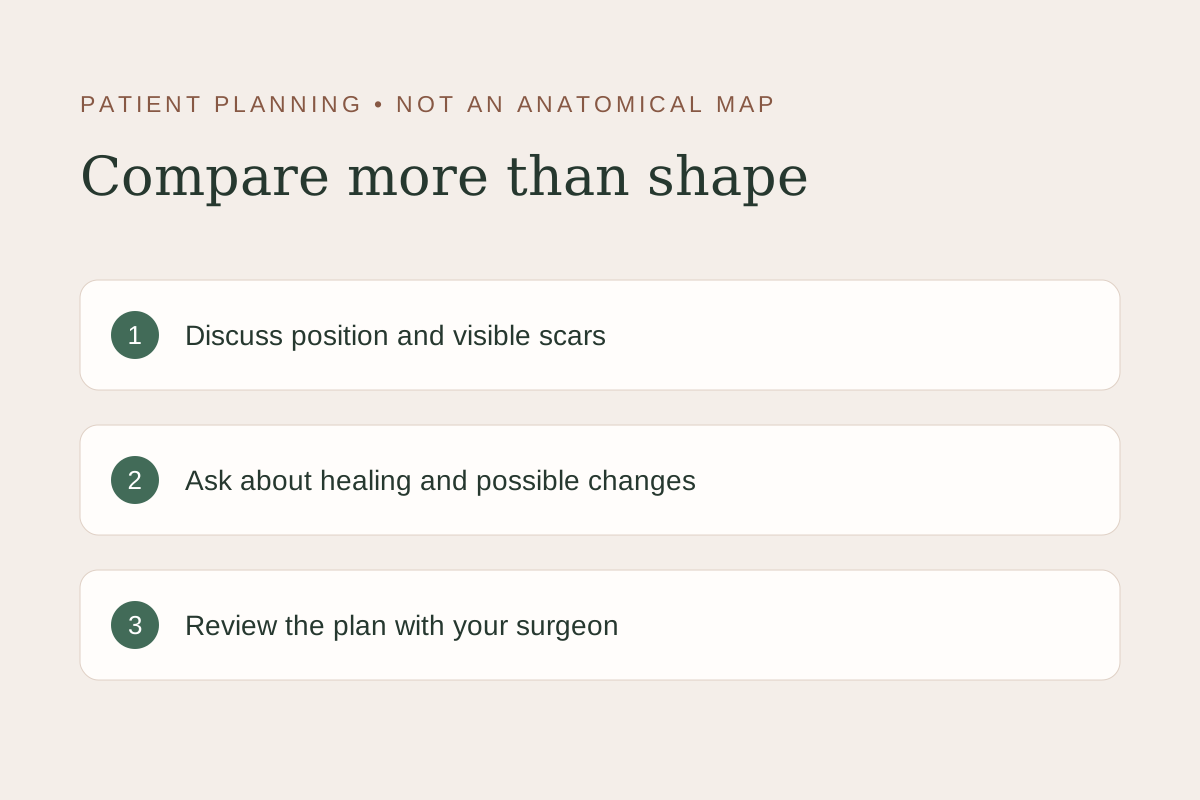
Before an operation, explain what concerns you in ordinary language. You may want to understand whether the belly button will look higher or lower relative to the surrounding abdomen, how visible its rim may be, and whether an existing asymmetry is likely to remain. Ask the surgeon to explain the expected position and shape and identify any limitations created by your existing anatomy or other scars. A realistic answer may include uncertainty.
Bring photographs only as a way to communicate preferences. Ask whether the examples show the same type of operation, similar starting anatomy and a sufficiently long follow-up. Images are selected examples, not a forecast. Lighting, posture, clothing and editing can affect what you see, and an attractive navel shape does not establish the safety or suitability of the operation. Ask to see the plan for your abdomen and to understand the trade-offs rather than choosing a surgeon solely by a gallery.
A surgeon cannot promise exact symmetry or a scar-free result. If a particular appearance is essential to your decision, say so before consent and ask whether it is realistic. Take time to consider the answer rather than interpreting an approximate drawing as a guarantee.
Will there be a scar around the belly button?
For the full operation, yes, the NHS describes an incision around the belly button and a resulting scar. The size, position and appearance should be discussed as part of your own plan. The lower abdominal incision also leaves a scar. Ask whether the mini technique proposed for you involves the navel and whether any additional incision is possible.
The NHS notes that scars can be raised or a different colour and may fade over time. ASPS says tummy-tuck scars may take several months to a year to fade as much as they will. These descriptions are general, not a promise of a particular timeline or appearance. Tell your surgeon if you have a history of raised or troublesome scars, previous abdominal operations, piercing scars, or prior treatment of the area. Ask what that history means for your choices and whether scar management is appropriate after your team confirms the skin has healed.
Do not start a product, massage, injection or device treatment just because it is recommended online. Ask your treating team when the area is ready and what it recommends for your individual situation. An external scar may be only one part of the decision: the aim is an informed choice about the whole operation. [1][2]
Can the belly button feel different afterward?
Changes in sensation are possible after abdominal surgery. The NHS lists numbness of the tummy as a common effect that can last months to years and notes that numbness or pain can occur. It does not provide an individual prediction about the belly button. Ask your surgeon which areas of your abdomen and navel could feel different, what is expected during recovery, and which changes should prompt a call. If you already have altered sensation or pain after a piercing, pregnancy or previous surgery, point it out before the operation.
Keep a clear record of what is normal for you and follow the written instructions from your treating team. If you experience severe pain or unexpected symptoms, contact the clinic promptly. Seek urgent local medical care for severe or rapidly worsening symptoms or whenever you cannot reach the treating team and need immediate assessment. An internet description cannot determine whether a symptom in your case is expected. [1]
What about a belly-button piercing or existing scar?
Show the surgeon any piercing, piercing scar, prior navel operation or abdominal scar, and explain whether you want to keep or wear jewelry afterward. Ask the team when jewelry must be removed, how the piercing may be affected by the planned incision and whether or when it could be worn again. Do not assume the existing channel will remain usable or that a new piercing will be safe at a fixed date; individual healing and the surgical plan matter.
If you previously had a C-section, hernia repair, laparoscopic operation or another procedure, describe it even when the scar looks small. The ASPS notes previous abdominal surgery may limit tummy-tuck results. Bring relevant operative reports if available and explain any known mesh or repairs. A surgeon can decide whether another assessment or additional information is needed before the cosmetic plan is finalized. If the navel itself is painful or you notice a bulge, tell a clinician rather than assuming a cosmetic procedure will address the cause.
What if an umbilical hernia is suspected?
A bulge or pain near the belly button deserves its own assessment. A tummy tuck consultation is not a substitute for diagnosing a hernia, and not every bulge is a hernia. Tell the surgeon about prior diagnosis, symptoms, previous repair, mesh and relevant imaging or operative reports. Ask whether an examination or referral is needed and whether addressing a hernia is separate from the cosmetic procedure. If a combined plan is proposed, ask who would perform each operation, why the approach is suitable, and how the risks, price and recovery plan change.
Stanford Medicine notes that a plastic surgeon may repair an abdominal or umbilical hernia during abdominoplasty or involve a general surgery colleague depending on its type and severity. That is a possibility, not a promise that combined surgery is suitable for you. Discuss alternatives and obtain individualized advice. Severe or rapidly worsening symptoms need prompt local medical assessment rather than waiting for an elective procedure or an overseas consultation. [3]
How do I compare a consultation in Korea?
Give each clinic the same goals and history, including prior operations, navel concerns and any relevant records. Ask for the full name and credentials of the surgeon who will examine and operate on you. Request a written description of the proposed procedure, a diagram of incisions, expected navel changes and the limits of an online estimate. Ask whether the surgeon or another member of the team will perform follow-up, who interprets medical discussions, and how you can ask questions before signing consent.
ReNu Plastic Surgery is one listed clinic to consider for a consultation. Its published body-contouring service page lists abdominoplasty: https://www.renuplasticsurgery.com/specialties/body-contouring . This confirms a published service, not independently verified outcomes or expertise in your particular anatomy. Confirm the operating surgeon and credentials directly and compare options according to the assessment, explanation and follow-up offered. No profile or photograph can promise a particular navel result.
Ask for a written quote that identifies the proposed operation, anesthesia, facility fees, medicines and follow-up, and ask what may cost extra. Ask what happens if an in-person examination changes the recommendation and whether deposits are refundable. If a plan sounds too certain before examining you, ask what remains provisional. A second opinion is reasonable when recommendations differ or you do not understand the rationale.
How should international patients plan recovery and the journey home?
Before committing to flights, ask the treating team how long it expects you to remain nearby, what follow-up appointments are planned, and what must be checked before travel. The answer depends on your operation and recovery; avoid relying on a single internet timeline. Ask what happens if you need to stay longer, who to contact outside office hours and where to seek urgent local care. Plan accommodation and help with daily tasks around the individualized instructions rather than a fixed promotional package.
Request written instructions in a language you understand, including care of the navel and incisions, permitted activity, warning symptoms, contact details and the follow-up schedule. Ask how to obtain the operative report and discharge summary for a clinician at home. Identify how a concern will be assessed after you leave Korea and whether remote advice can be followed by in-person care when necessary. Keep sufficient flexibility in your plans for the team to assess your recovery before departure.
If severe pain or unexpected symptoms arise, contact the treating team promptly. Seek urgent local medical care for urgent symptoms instead of waiting for a message to be answered. Do not make a travel decision based only on a photograph of the navel or on someone else's recovery story. Get emergency medical help immediately for chest pain or sudden shortness of breath; do not wait to contact the clinic. Contact your surgical team promptly for concerning wound changes or fever, and seek urgent local assessment if you cannot reach them or symptoms are worsening. [1][5]
A consultation checklist for the belly-button decision
Ask the surgeon: Which operation do you propose, and why does it fit the location of my excess skin? Will the belly button be freed and brought through a new opening? Where will the scars likely sit? Could my existing piercing, scar, asymmetry or previous operation change the plan? What can and cannot be predicted about shape, position and sensation? How would the alternatives compare, including a mini approach or no surgery?
Also ask: What are the major risks and how would a problem be assessed and treated? Who will perform surgery and follow-up? What will I receive in writing, what is included in the quote and what might change after examination? How long should I plan to stay in Korea, who can I call after hours, and how will I arrange care at home? Can I take the consent information away and return with questions before deciding?
A worthwhile consultation should connect the answers to your examination, make uncertainty clear and allow you to decline or postpone. This guide is educational and has not undergone independent clinician review. It cannot replace medical advice tailored to you.
Explore the profiles mentioned in this guide
Use these source-linked profiles to prepare questions and confirm your individual plan directly.
Continue with the related guides
Put this information into your consultation
Use the consultation checklist and budget worksheet to record your questions. Explore tummy tuck clinics in South Korea and doctor profiles before asking a clinic about your individual plan.
Sources & further reading
Source links support the topic or the attributed provider details. Practical preparation prompts are editorial guidance. Checked 3 November 2026