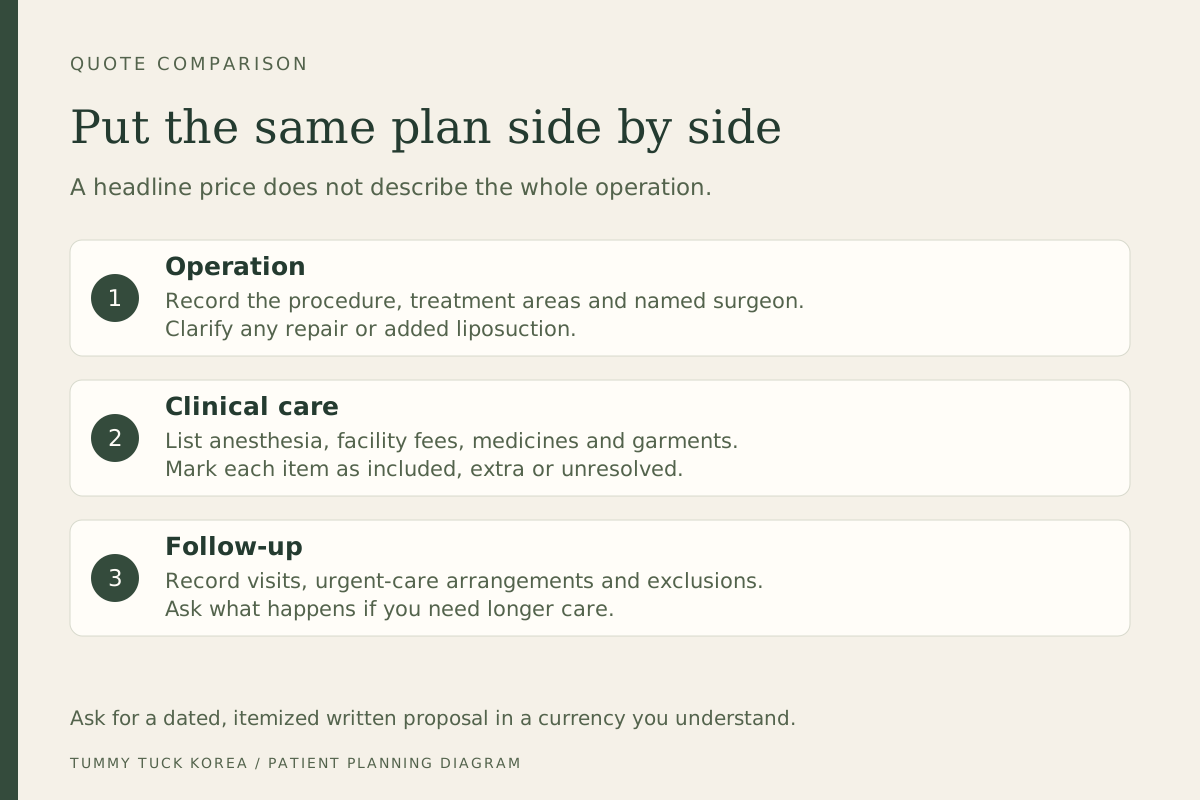
- Combine the clinical, practical, and financial plans.
- Mark every unresolved assumption visibly.
- State why your next step makes sense, including if it is to wait.
Can you explain the proposed operation and its limits?
Write the named surgeon, clinic branch, proposed procedure, and the concern it is intended to address. Add the most important limitation and the alternatives discussed. Mark whether the plan is final or still depends on an examination or test. If you cannot write this without copying a marketing slogan, ask for a clearer explanation. Keep the surgeon’s written plan beside your summary so you can compare them. Do not turn a possible result into a guarantee. A good summary preserves the uncertainty that remains and identifies who will resolve it. It should also make the option of not proceeding visible rather than treating booking as the inevitable end of research.
Summarize the recovery responsibilities
Record the support required after discharge, the planned reviews in Korea, the process for travel clearance, and the follow-up arrangement at home. Name the people or services responsible for practical help. Add the after-hours clinical contact and the local route for urgent care. If any item is only an assumption, mark it as such. The question is whether you can realistically follow the proposed plan, not whether a generic recovery timeline sounds manageable. Consider work, childcare, transport, and accommodation together. A clinical recommendation and a practical plan need to fit each other; neither is complete if the other relies on arrangements that have not been made.
Summarize the evidence about the provider
List the source for the surgeon’s identity and qualifications, the source confirming the procedure, and any institutional status you checked. Distinguish independent confirmation from the clinic’s own description. Keep reviews and photographs in a separate category from credentials and written terms. Do not create a quality score from incomplete information. Ask whether the unanswered questions could materially change your choice. If so, resolve them before treating the comparison as finished. The aim is a traceable basis for your decision, not a claim that you have conducted a formal clinical audit. A transparent record of limits is more useful than an impressive-looking checklist filled with assumptions.
Summarize the financial commitment
Record the itemized estimate, payment schedule, deposit terms, exclusions, and travel budget. Add the outcome of your insurance questions and the cost of practical support. Include a scenario for a changed schedule without assigning a made-up probability. Make clear which amounts are confirmed and which are estimates. If the procedure changes, ask how the financial agreement changes too. Avoid comparing only the headline surgical fee with a budget that includes every expense at home. Use the same scope for each option. This summary does not replace contractual or financial advice; it helps you see whether the plan you are considering is the plan you can actually fund.
Write your reason for the next step
Finish with a short statement explaining why you intend to proceed, seek another opinion, clarify a point, or wait. Name the trade-off you accept and the condition that would make you reconsider. Share the summary with a trusted person if that helps you think, while keeping the decision your own. Ask the clinic to correct factual misunderstandings before paying. Keep the document dated and update it when the plan changes. It is not a consent form, medical clearance, or endorsement of a clinic. Its value is that you can explain your next step in clear language, based on actual information, without relying on momentum, a promotion, or an imagined guaranteed result.
Read the summary as if you were helping someone else
Set the document aside briefly, then read it with a simple question: which sentence depends on an assumption I have not checked? Look for words such as included, guaranteed, available, and cleared. Replace them with the actual written terms or mark them unresolved. Check that a clinic’s marketing claim has not become your own factual statement without a source. Ask whether a trusted person could find the next appointment, emergency contact, and main financial commitment from the summary. If not, simplify it. This review is not a formal safety certification. It is a final clarity check that keeps the plan understandable and makes it easier to change course when new clinical information, practical limitations, or your own preferences alter the decision.
Put this information into your consultation
Use the consultation checklist and budget worksheet to record your questions. Explore tummy tuck clinics in South Korea and doctor profiles before asking a clinic about your individual plan.
Sources & further reading
Source links support the topic or the attributed provider details. Practical preparation prompts are editorial guidance. Checked 20 October 2026